Showing posts with label almond. Show all posts

Saturday, 30 March 2013

Day 13: Vegan Almond or Nut Cookies Shaped Like Pears - March 30, 2013


Everybody likes cookies.  They are easy to eat, small enough to enjoy with a coffee or tea, and just sweet enough to satisfy a craving.  And, many times, one is enough.  Well, we thought it would be nice to have a homemade treat on hand, since we are expecting company over the next few days.  When someone visits, it is important to have something to offer, food or drink.  So, we chose to make a few cookies for our guests.  Typically, these cookies are called Pine Nut Cookies, but traditionally  they were made from marzipan (almond paste).  And, although these are not originally Greek, adaptations of the original marzipan cookies have comfortably made their way to a common sight in many Greek bakeries and homes.

Marzipan is rather expensive, and can be bought in tubes, cans, or in various pre-made shapes.  We could also make our own by grinding the almonds with some sugar to make the paste.  If you don't really like the flavor of marzipan, there should be alternatives.  And, there are, especially with these cookies.

We could use pine nuts or walnuts and end up with similarly delicious treats, just different flavours.  Today, we chose to be a little more traditional and use almonds.  But, our variation to the recipe is that we used toasted, sliced almonds.  That, we thought, would bring another dimension to the flavour of these pear-shaped treats.

Why pear shaped?  Well, first, it is very easy to just pinch an end and make the stem part.  But, pears are representative of how ancient the Greek civilisation is.  According to the author of the excellent cookbook, The Olive and the Caper, "Pears originated where Greeks did, on the west of the Urals above the Black Sea.  The remains of wild pear are found in Mycenaean sites."   So, with the pear being so intertwined with Greek food for so long, and nuts having been used forever in Greek culinary treats, putting the two together seemed like a good fit.  These were easy and quick to make, and they look so cute!


For this recipe, you will need:

1 1/2 cups nuts (8 ounces)
1/4 cup sugar
2 1/2 Tablespoons flour (all-purpose)
2 Tablespoons Triple Sec (or other orange-based liqueur)
32 whole cloves
2 Tablespoons confectioners' sugar (icing or powdered sugar)

Remember, we used toasted almond slices that we had on hand, but you can use almonds of any kind, walnuts, pine nuts, or pistachios (shelled) to make these cookies.  This recipe yields about 32 cookies (for today's blog entry, we used half the recipe for the pictures below).


First, preheat the oven to 375° F (190° C).  While the cookies are in the oven, we had to lower the temperature to 350° F (175° C), but the higher temperature was important at the start of the baking.  Then, start the cookie dough.  In a food processor, combine the nuts and sugar and grind to a fine powder.  You will see the oil start to separate out of  the nuts, and then the sugar will absorb the oil and you will watch the nut mixture turn pasty.  When that starts to happen, add the flour and the liqueur.   Just pour them into the food processor and use the pulse function to get the ingredients together.  Now, continue to process this until the dough holds together by itself.


Take the dough out of the food processor and make a log from it.  Roll it into a log or cylinder that is uniform, since this will be divided into equal pieces to make the cookies.  Let the log rest for a moment to make sure that it holds its shape and does not fall apart.  You can see that we left our nuts a little more coarse than fine.  We agreed that we like a little texture and a little bite to a cookie, and would prefer that it is not creamy.  So, we did not puree the nuts as well as the directions in the cookbook suggested.  So, when you look at our dough, it does look like it is falling apart, but it is just so coarse that it took a little more pinching together than if it had been more finely ground.


Now, cut the log into 32 equal pieces.  As mentioned, we made half the recipe, so you will not see 32 in the pictures below.  There were different ways to cut the log into equal pieces -- use a knife and cut, just as you would refrigerator cookies.  Or, use your fingers and pinch equal amounts off the log and lay the pinched portions aside as you go.  Whichever way is easy for you, do that.  You could even use a scale to weigh each piece.  We chose to pinch our pieces so they felt like they would be the right size.  Sometimes, we know how big we want the bite to be, and we may not have 16 pieces, but the pears seemed like the right size for us.   So, pinch or cut the pieces and lay them aside.


Now comes the fun part.  Using the palms of your hands, and your fingers, roll the chunks of dough into ball shapes and place them on a cookie sheet.  Just to mention that we always line our cookie sheets with either parchment paper or with the reusable silicone mats.  Because these cookies are very oily when they are raw, we thought parchment would be the best choice today.  After you have rolled each chunk into a ball, use your index finger and thumb and pinch one end of the ball.  Pinch with these two fingers and turn the ball in your hand to keep all the edges rounded.  This was the hardest thing to photograph!  But, you pinch and turn, pinch and turn, and then lay the pear shaped cookies on the cookie sheet.


Now, add the stems to the pears.  Using the whole cloves, poke a clove right into the pointed side of the cookie to give the appearance of a stem coming out of a fruit.  Do this for each cookie.  When we sat back and looked at the whole tray of cookies, we thought it was so cute, and the cloves really do have the right shape!


Bake the cookies in the oven for 5 minutes at 375° F  (190° C), then, turn down the temperature to 325° F (165° C) and continue to bake until the cookies are lightly golden on top -- about 15 minutes total.  They will have the same golden colour as a toasted nut -- whatever nut you are using.  Keep that in mind when baking.

Let the cookies rest for only a moment, and then, using a sifter, sprinkle the powdered sugar (icing sugar, confectioners' sugar) all over the cookies.  It's the same process as making kourambiedes (see last year's blog entry by clicking here).  You want to sprinkle the powdered sugar on the warm cookies so the sugar melts a little bit and makes a bit of a glaze or a coating on the cookies.  You can add more powdered sugar later if you want white cookies, but for now, sift enough on there to cover the entire top of the cookie.


Then, the cookies are ready to serve.  You can add more powdered sugar, or you can leave them as they are.  Some were warmer than the others, and the sugar melted more on those cookies.  But, we know for sure that they looked beautiful!   We thought that we had baked our batch a little too long, and they were maybe a little dark for what we wanted.  But, then, we realised that we had started with some toasted almonds, so our dough was already darker from the start!

We can keep these cookies in an airtight container for up to 2 weeks.  It is such a simple recipe and not too time consuming to bake.  Really, the whole process, start to finish, took us about 30 minutes.  We think that most people can find 30 minutes in a day to make some cookies.  And, if we wanted to make different shapes, we probably could.  We could just leave the cookies as balls, put a clove in the top of the ball and call them apple shaped!  Or, we could make slices from our original log and omit the cloves, and just have cookies.  We don't think the shape of the cookie matters as much as how delightful it tasted.  Perfect for company, perfect for Great Lent!


"A tree is known by its fruit, a man by his deeds. A good deed is never lost; he who sows courtesy reaps friendship, and he who plants kindness gathers love."

St. Basil the Great

Monday, 25 March 2013

Day 7: Γλυκό Του Κουταλιού Με Σταφύλια και Αμύγδαλα - Greek Spoon Sweet with Grapes and Almond, March 24, 2013


Γλυκό του κουταλιού is a household phrase, and it always refers to a delightful treat that is offered to unexpected company.  It is served with a glass of cold water, and it is a simple pleasure in the Greek
home. Here in North America, we may know it as 'spoon sweets', which has several interpretations. For us, a spoon sweet should be self-explanatory -- a sweet eaten with a spoon. That is a huge category of foods. Spoon sweets are specifically a caramelised, drippy, sweet, fruity, nutty delight, that takes only two spoonfuls to fill any sweet tooth. So, today, we created one from grapes. Γλυκό σταφύλια με αμύγδαλα is sweet grapes with almonds.

Many homemakers have their own way of making γλυκό, and use a variety of fruits or nuts to do so. Grapes are a popular choice because of the plentiful amounts available all year. The recipe is basic, and can be used with any fruit. We have made this with watermelon rind, almonds, quince, grapes, and orange peels. Our favourite, by far, is the grape. There is something about the sweet squish of the fruit in your mouth, when coated with a lovely caramel-like syrup. And, adding the almonds gives another dimension to the texture, by adding that lovely crunchiness. Here is what we did to make γλυκό του κουταλιού:


You will need:
1 pound of grapes, washed and stemmed
1 cup water
2 cups granulated sugar
juice of 1 lemon
1/2 cup slivered or sliced almonds


First, toast the almonds. This can be done in the oven, but we found that the frying pan was fast and easy in order to see the colour and that the almonds did not burn. Toast the almonds long enough that at least half of them are golden brown. Set these aside so they are cool when you add them to the glyko.


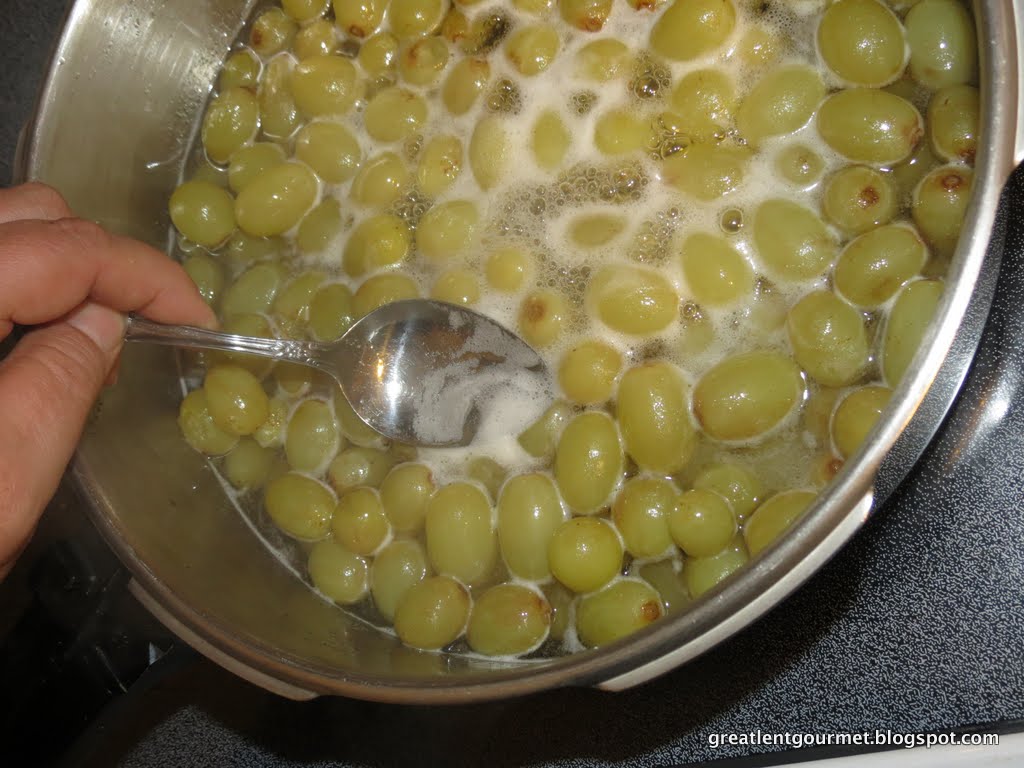
Put the grapes in a pot.  Do NOT add anything to the pot -- just grapes.  When you turn on the burner, you are cooking the grapes and making all the juice run into the centre.  It is like warming a lemon before juicing -- you want more flavour so you heat it.  Heat the grapes.


The grapes start to change colour and you see them turning a more whitish-yellow tint.  This indicates that those grapes are ready.  Continue to heat the grapes until they are all that same colour.

Next, add the sugar and the water.  Make sure the grapes are all coated with the sugar before adding the water.  Then, when you add the water, mix well so the sugar all dissolves.  The ratio for sugar to water is 2:1, and should be the same if you make more than one pound of grapes.  Interestingly, the ratio of grapes to sugar is also 2:1, and if you remember these two ratios  you always will remember the recipe!


As this mixture begins to boil, you will need to remove any foam that surfaces.  Using a spoon, carefully scrape the foam layer off the top of the syrup.


As the mixture cooks and the syrup thickens, you will see the change of colour in the liquid.  That means that the sugar is beginning to caramelise.  You will then have to watch closely, turn the heat down, and let this cook uncovered, on low heat, until the syrup thickens.  This will take about 30 minutes, depending on your stove.


Then, add the lemon juice and the nuts.  Stir well so that the nuts and the grapes are evenly distributed in the syrup.  Let this cool completely before serving.


Some people will add vanilla flavouring to the mixture, or use rose water instead of lemon juice. That's the beauty of a recipe like this -- everyone has the same basic recipe but adds a little something to make it their own. For us, we like the tartness of the lemon mixed with the sweetness of the syrup. And since γλυκό του κουταλιού is typically served with a glass of cold water, the lemon and sugar stays on the tongue to make the water taste better, too. Γλυκό του κουταλιού is a sweet, drippy treat that takes a little time to make, but is worth it in the end.


YouTube video:  The Sunday of Orthodoxy (Source: https://www.youtube.com/watch?v=YZB56qkfzJM)


Wednesday, 7 March 2012

Day 18 - Milk Alternatives during Great Lent

In the recent past, dairy products have received a failing grade for a variety of reasons. In the U.S., for example, the use of Bovine Growth Hormone (rBGH) in dairy cows has sparked great debate about the merits of enhancing milk production at the expense of potential health risks for those consuming such milk. Consumer backlash has been enormous; this has even caused some of the biggest retailers to respond by curtailing or eliminating the sale of milk and milk products that contain BGH. Walmart, for example, has heard the message from its customers loud and clear and has responded in kind. Even in Canada, Health Canada (federal Ministry of Health) has created a Q&A web page to respond to consumer concerns (see here).

On the other hand, much evidence from various sources, including the influential research group, Blue Zones, has concluded that goat's milk is an important component of the incredible longevity and good health of the population of the Greek island of Ikaria (click here). 

So, what's a person to do? It is not the role of our humble blog to malign milk, a source of good nutrition for hundreds of millions of people. We are, however, genuinely curious to explore the value of  milk alternatives, both as a source of nutrition and as another resource that the Orthodox Christian can use to sustain their health during the period of Great Lent. So, towards that end, we sought to educate ourselves in the field of milk alternatives.

There are dozens, if not hundreds, of milk alternative brands throughout the world. In Europe, Asia and North America the biggest brands are large multinationals such as Coca Cola, Unilever and Danone. 


Wanting to see how products from all three categories (soy, almond, rice) can be used during Great Lent, we went out and purchased a variety of prominent brands. Over the next few weeks we will examine each of the products shown below in a variety of contexts: flavour, suitability for use in food and beverages, nutritional value. We are really excited about some uses that we have in mind which we will keep secret, for now. So, until our next blog entry about milk alternatives, please read the package information and nutritional breakdown of all of the following products we purchased.

Front view (left to right): Blue Diamond brand Almond Breeze (Original) almond-based beverage, SoGood brand Original soy-based beverage, Silk brand fortified Original soy-beverage, Ryza brand whole grain brown rice beverage.
Left side-panel view (left to right): Blue Diamond brand Almond Breeze (Original) almond-based beverage, SoGood brand Original soy-based beverage, Silk brand fortified Original soy-beverage, Ryza brand whole grain brown rice beverage.
Right side-panel view (left to right): Blue Diamond brand Almond Breeze (Original) almond-based beverage, SoGood brand Original soy-based beverage, Silk brand fortified Original soy-beverage, Ryza brand whole grain brown rice beverage.
Above (left to right): Front panel of two flavours (Original and Chocolate flavours, respectively) of soy-based beverages from Silk, a WhiteWave Foods brand from Dean Foods.
Above (left to right): Left side-panel of the marketing descritpions of two flavours (Original and Chocolate flavours, respectively) of soy-based beverages from Silk, a WhiteWave Foods brand from Dean Foods.
Above (left to right): Right side-panel with the ingredients list and nutritional facts of two flavours (Original and Chocolate flavours, respectively) of soy-based beverages from Silk, a WhiteWave Foods brand from Dean Foods.


“Bless those that curse you, and pray for your enemies, and fast for those that persecute you. For what credit is it to you if you love those that love you? Do not even the heathen do the same?” But, for your part, “love those that hate you,” and you will have no enemy." 


From the Didache, Fasting and Praying for Enemies. Did. 1.3