Showing posts with label potato. Show all posts

Thursday, 21 March 2013

Day 4: Tasty Taramas made with Potatoes. March 21, 2013


Taramas is a staple food during Great Lent.  It is one of those curious lenten dishes because it is made from fish roe, but we are not allowed to have fish.  The roe, however, is not counted in the category of meat or fish.  Therefore, we can make taramosalata and eat it.  In the past, we have made this with bread -- cutting off the crust of stale white bread and then soaking it in water to add to the whipped roe.  But  this time, we made tarama with potatoes.  This, for us, was a first.  We had heard of other people doing this, but potatoes were for skordalia, not taramosalata.

So, we tried a  new recipe for this.  We found an easy recipe online, but omitted the olive oil and used vegetable oil instead.  The folks at Yumly really made it easy for us.  We had all the ingredients, and could not let Great Lent begin without having taramosalata on the table.  For this recipe, you will need the following:


2 large potatoes
5 ounces tarama (cod roe)
1 small onion, chopped
1 1/2 lemons, juiced
3/4 cup oil
garnish with lemon, parsley, or capers


Peel the potatoes and cut into small chunks.  Put them in a pot of water and boil them until they are fully cooked.  They should be cooked long enough as if you were making potato salad.  Drain the water when they are done cooking, and keep the potatoes aside for a future step.  In the meantime, while the potatoes cook, chop the onion and puree the tarama with lemon juice.


The recipe called for 5 ounces of tarama (142 g), but we thought that was too much, and we cut it to 3 ounces (85 g).    This was approximtely half the jar of tarama.


Whip the tarama until it is light and fluffy.  This will take about ten minutes (yes, 10 minutes).  The tarama will have the consistency of mayonnaise.


You need the juice of one and a half lemons.  Juice the lemons with your favourite juicer to remove pulp and seeds.  Then, add the lemon juice to the whipped tarama.  The lemon juice may make the tarama a lighter shade.


You will need one small onion.  We had very large onions, so we cut ours in four, and used one fourth of the whole onion.  Cut it into small pieces that will fit into the food processor or blender you are using. 


Add the onions to the food processor and whip until it is completely smooth.  Then, let this rest and work the potatoes.


In a separate bowl, mash the cooked potatoes.  You can use a fork, potato masher, or a hand blender.  Remember, the more you mash, the smoother your taramosalata will be.


We chose to mash our potatoes enough to have some texture, some chunks still intact.  You can see the chunks of potato in the bowl.


Fold together the whipped tarama mixture with the potatoes.  Fold until the colour is uniform and everything is fully mixed.  


Taramosalata is ready to serve.  We garnished with a slice of Meyer Lemon, but you could use capers, chopped red onions, parsley, or whatever you like.  Keep this chilled until serving.

When we made this recipe, we were skeptical with the amounts and the statement that this would serve 7 people.  Of course, we do not believe that this serves 7 Greek people!  Regardless, it was delicious.  One of the people who tasted this said, "I don't usually like tarama because it's too fishy.  This one has a nice, mild fish taste."   Another taster said, "This is different because it's chunky.  It's like fish mashed potatoes."  We are not sure if that is good for others or not, but the taster was honest.  Our last comment from a taster was that this was "... creamy and good.  I don't need the bread, I just need a spoon!"  We think that was the best compliment we could have received... that and, there were no leftovers!  

We would use this recipe again because it was so easy to follow, and easy to make.  The directions were clear, and simplified.  Mostly, we would make this recipe again because we all enjoyed eating it!  After all the years we have made taramosalata with bread, we find that the potatoes were a cleaner way to make this.  No more dipping our hands in the water and squeezing the bread.  Potatoes are always on hand, whereas sliced white bread is not, so that makes this a more convenient recipe for us.  If you recall, we made taramosalata  in Great Lent Gourmet 2012 (Day 12) but then we were focusing on the differences of making it with the two brands of roe that are readily available in the store.  This time, we wanted to focus on the recipe itself, regardless of which brand of roe one is using.  So, we can confirm that taramosalata made with potatoes is delicious and easy.  For us, it will be a staple food during Great Lents to come.


Above all, strive to love your neighbor; for in his love consists love for God.
- St. Macarius of Optina

Wednesday, 20 March 2013

Day 3: Boiled Potatoes with Tahini - March 20, 2013


Boiled potatoes sound rather plain, and many people may choose other ways to prepare potatoes.  On Clean Monday, we boiled some potatoes with herbs and seasonings, and they were flavourful, but less enticing than many of the more seasoned foods on the table.  Today, we found a nice way to prepare boiled potatoes with flavour that may be more appetizing than just plain boiled potatoes.

The Greek Monastery Cookbook (by Archimandrite Dositheos) is a good one for Great Lent because the Monks specify recipes for oiless fasts, fasts with oil and wine as well as for non-fasting periods.  This recipe is for a strict fast, with no oil or wine.  This book presents uses for tahini in more ways than we would have originally thought.  A challenge in this cookbook, though, is that we don't always understand the directions.  This recipe, thankfully, was clear and simple, and took us less than one hour to make. This potato-based side dish was easy, and we had all the ingredients on hand, so that added to the appeal of the recipe.  We did not have ten people to serve today, so we cut the recipe in half.  We are giving you the amounts needed to serve 5 people.


For this Boiled Potatoes with Tahini recipe, you will need the following:

1 pound potatoes (about 500 g)
2 soup spoons of tahini
some parsley (about 1/2 cup) chopped
juice of 1 1/2 lemons
1 medium onion, finely chopped
salt, as needed


First, boil the potatoes in salted water.  This did not take too long (it depends on the size of the potatoes).  If you like, the cookbook suggests this:  "Note: Instead of boiling, you may bake potatoes for an hour, in an oven at 200 ℃ (392 °F)"


To check the doneness of the potato, and to make sure that it is cooked in the middle, stick a fork or a knife in the middle and watch the potato slide off the fork (or knife).  If the potato does not slide off by itself (without you shaking the fork) then it is not quite done.  Check for doneness every five minutes thereafter. 


Peeling the potato was easy.  The skin is quite soft and you can just scrape it off with a knife -- either the dull side or the sharp side.  The peel even comes off  by rubbing it with your fingers.


Make sure to get all the spots off the potato!


Peel and cut the potatoes into pieces.  Allow the potatoes to cool enough for you to be able to handle them.  For every person, this amount of time will vary, but you do want them still warm when you mix them together with the other ingredients.  We cut these into large cubes, the same size that we would use for any potato salad dish.  You can cut them large or small, but the larger the pieces, the prettier they look with the chopped onions.


Spoonfuls of tahini.  This is a soup spoon, just like the book said.  Please note that on page 6 of this book there is a pretty useful conversion chart (however, a shortcoming is the confusion of using terms such as "1 tablespoon = 15 ml" while not explaining in detail if a soup spoon is exactly the same thing as a tablespoon.).


Adding the lemon juice a little at a time was helpful.  That way we could taste to determine if there was enough lemon juice with the tahini.  We wanted to taste a hint of lemon without overpowering the tahini.  We thought the one and a half lemons was just shy of what we thought as "just right", so we decided to use the juice of two whole lemons.


The tahini changes consistency as you add the lemon juice.  You will see it become lighter in colour and thicker; then it will just get lighter in colour and thinner with many air bubbles (see photo below).


Prepare the tahini as follows:  Beat the tahini with the lemon juice until it thickens.  Then, dilute slowly with hot water until it becomes a diluted sauce.  We beat the tahini and slowly added the lemon juice.  We thought that when the tahini and lemon became fluffy with air bubbles, and it was very thick - that would be enough for the mixing.  But, then, we added the water, and the sauce took on the consistency of squeeze-bottle mustard -- just thin enough to stir.  


Add the onions and some salt.  Combine the ingredients so all the onions are fully coated with the sauce.  This is the sauce that will go on the potatoes.


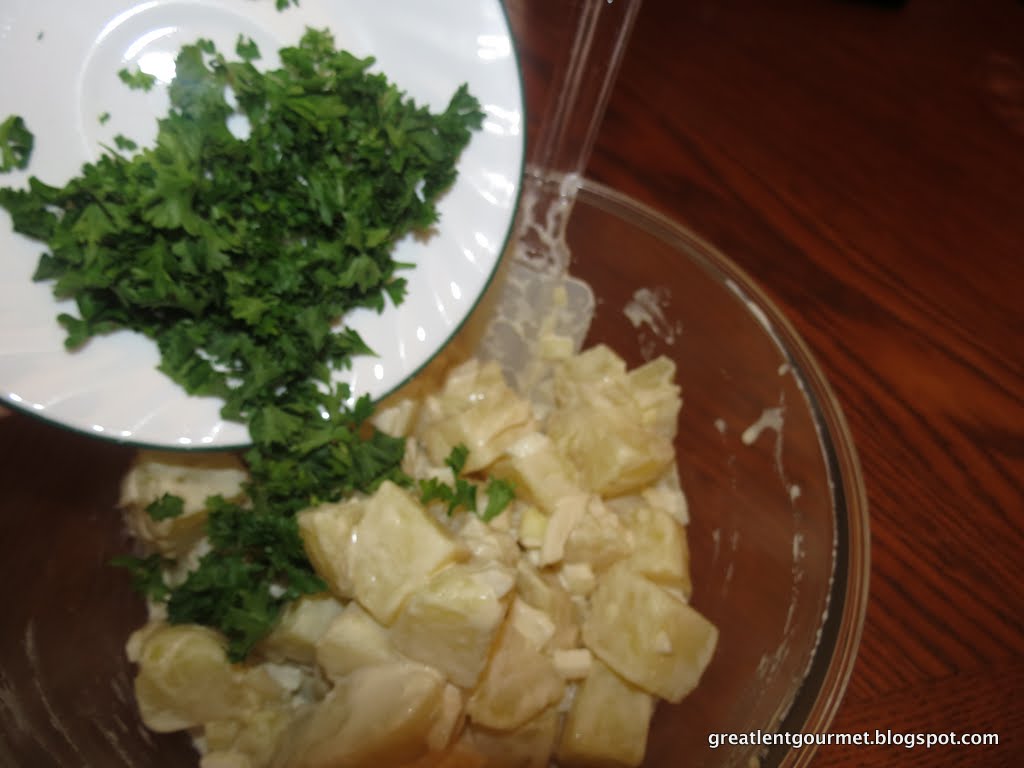
Pour the sauce over the potatoes.  Mix well to ensure that all the potatoes are fully coated.  Then, add the parsley and mix again.  We found that using a rubber spatula and folding the sauce with the potatoes, and then folding the parsley into the mix separately worked well, so we did not smash the potatoes.  We chose yellow fleshed potatoes, which, when cooked become creamy and velvety in texture.  They are fragile when cooked, so we wanted to make sure to leave the chunks intact.  Mix well and finally serve.  One of the suggestions of the original recipe is to sprinkle mortar-pounded walnuts.  We did not like the idea of the walnuts with the potatoes, so we voted against nuts, even though they would look beautiful on top.


Serve potatoes either warm or cold.  Our personal preference was to have the potatoes warm.  When it was cold, it was admitedly good, but it was not as good as when it was warm.  We loved the creaminess of the sauce with the creaminess of the potatoes.  This recipe was an absolute winner in our family.  It's funny; we trust monks for many things, and now we are more certain that we can trust them for cooking recommendations also!

This potato recipe was great.  It was relatively clear, concise, and appropriate for a strict fast.  The flavours and textures were a nice complement to the steamed vegetables we had.  And, the bright green of the parsley with the white of the tahini and the gold of the potatoes really made for a beautiful presentation.  As we ate the potatoes, we did not feel like it needed any more lemon, but some of us would have preferred it with a little more salt.  We all agreed that if we put this potato dish in the food processor with a little garlic, that would make some great skordalia!  Who knows, maybe we can create a new recipe?