Showing posts with label onions. Show all posts

Sunday, 7 April 2013

Day 20: Savoury Vegan Tomato Potatoes with Onions and Cinnamon - April 6, 2013


Potatoes are a staple food for the Greek diet.  Even if there is rice on the table, we may still offer potatoes also.  There are so many ways to prepare potatoes, that sometimes, it is hard to decide which method to use.  We often roast the potatoes with lemon and oregano, but today we wanted something a little different; so we decided to use a tomato sauce as the backdrop of this potato dish.

 The tomato sauce with the potatoes will make just the right side dish for our family today.  We like kokkinisto (foods in a smooth tomato sauce) and we like yiahni (foods in a chunky tomato sauce), so why not tomato sauce on potatoes?

This will take about 15 minutes to assemble, and takes about one hour in the oven.  If this is your choice as a side dish, then you can get it in the oven while you prepare something else.  It is that simple, and needs little attention.


For this recipe, you will need:

about 6 large potatoes, peeled and cut into wedges
1/2 cup or so of tomato sauce
some water
4 TBSP oil
salt and cinnamon to taste
1 onion, chopped


Our first thing to mention is that we did not have large potatoes today.  But this recipe, as with any kind of oven-roasted potatoes can be made with large, small, or any size of potatoes. For today's dish we had small new potatoes available to us to use.


Cut the potatoes, preferably into wedges.  We did not peel ours because they are small new potatoes with a very thin skin.  Let's also not forget that the skin has many nutrients!  We did, however, wash the potatoes well.  And, we also chose to cut them into halves since they were so small in the first place.  Put the potato pieces in a large mixing bowl.


Now, in that bowl, add the chopped onions, tomato sauce, salt and cinnamon.  You want to add everything to the bowl except the water and oil. Keep that for a later step.  Mix well to ensure that all  the potatoes are coated well with the tomato and spices.


Now, add some olive oil.  We add enough to circle the bowl two times.  It seems like enough oil to lightly coat the potatoes, but not enough to saturate the tomato sauce with oil.


Now, add some water.  You need about 1/2 cup or so (about 125 mL), but will need to add more before putting it in the oven (see next step).  Mix well so all the potatoes are evenly coated and covered with sauce.


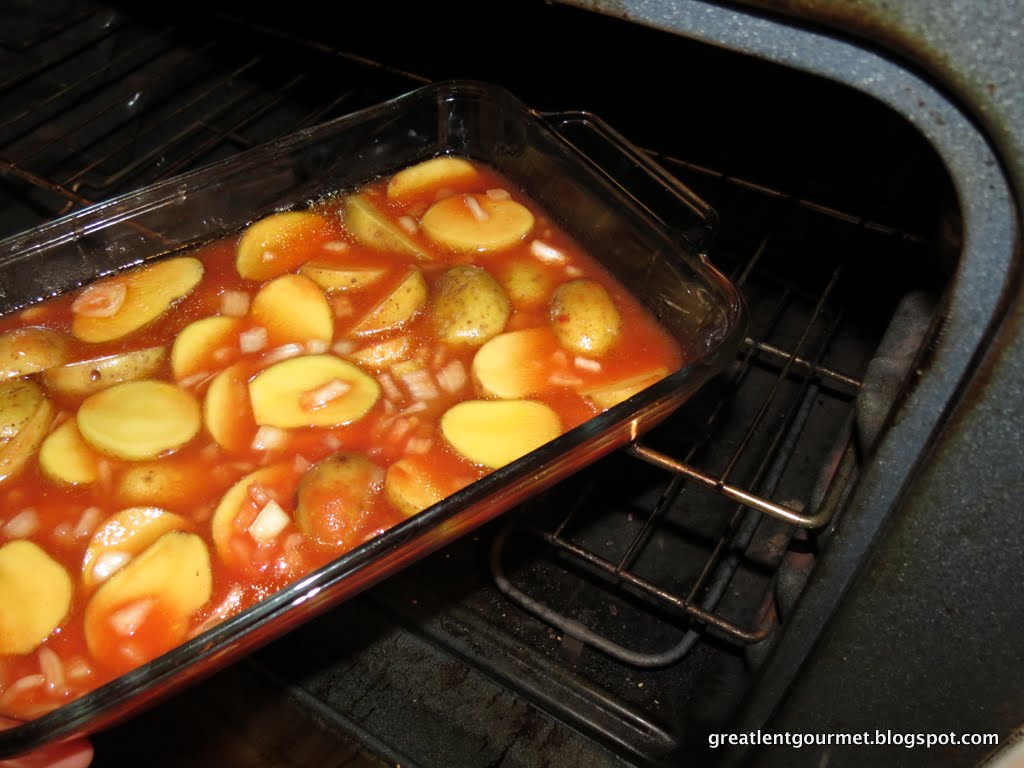
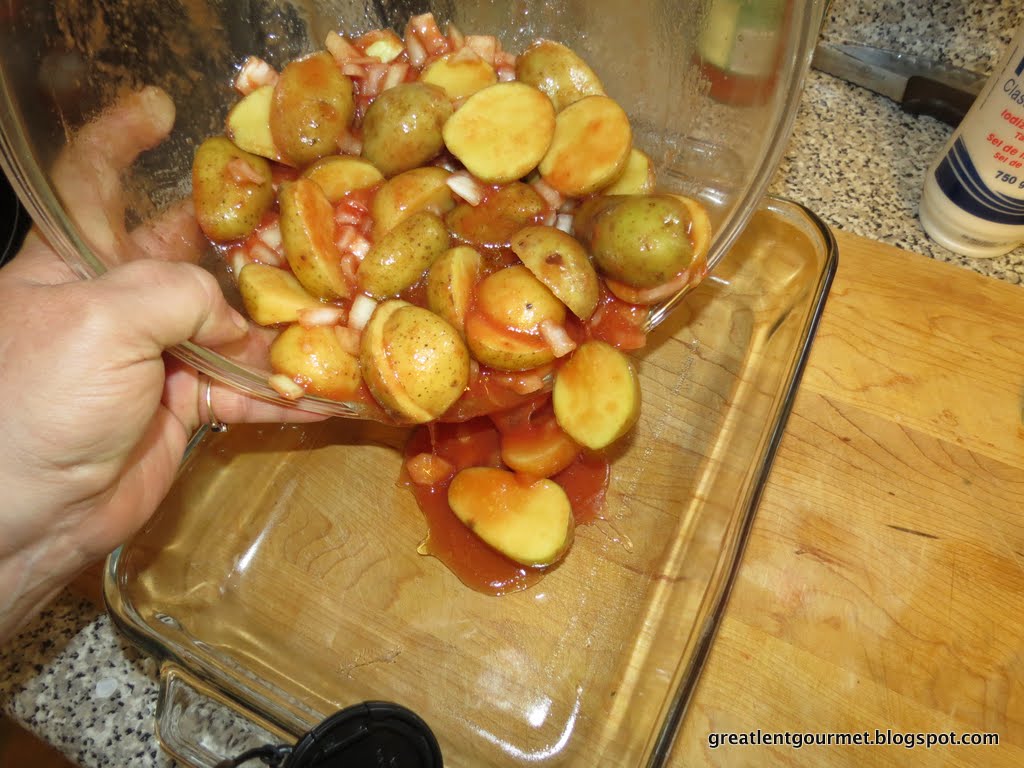
Once it is all mixed well,  pour this into a glass baking dish.  Add more water until the water level in the baking dish just covers the top of most of the potatoes.  It is okay for some of the potatoes to stick out.  Remember, if you add too much water, the potatoes will be soggy and wet when they are cooked.  If you don't add enough, the potatoes will not have that creamy yum that they usually get in the oven.  Make sure that everything is well distributed in the baking dish.


Bake at 350° F (about 175° C) for about 1 hour until the potatoes are soft and the colour on top is a golden baked colour and the water has mostly evaporated.  You want to make sure there is still some liquid in the potatoes, and you may need to add water through the baking process to make sure there is enough.  If you find that there is not enough, then add a little boiling water at the end and mix carefully before serving.  Serve these potatoes hot and enjoy.


We liked these potatoes a lot.  They were easy enough to make and even easier to eat.  The creaminess of the potatoes really balanced the tanginess of the tomato sauce.  The one adjustment we would make for the next time is to add a little more cinnamon.  There was just the slightest hint of cinnamon, but we wanted more, so we would increase from a pinch of cinnamon to a full teaspoon or two.  We also may cut the onions in a different shape for variety.  Sliced onions would look more appealing on the dish, so we will consider that adjustment, also.  Overall, this was a great addition to our meal.  We would not hesitate to make this again and again, and we believe that this recipe will be well received by most people (unless you don't like cinnamon with a savoury dish).  In fact, we liked it so much that members of our family suggested that we make it again for Easter Sunday with our lamb dishes.

"Pray as though everything depended on God. Work as if everything depended on you."

St. Augustine

Monday, 1 April 2013

Day 15: Spicy Chickpea and Aubergine (Eggplant) Stew, April 1, 2013


Today's entry comes from a cookbook that we read often, but do not really use. But we found one recipe that seemed so interesting to us, and we would never have imagined putting eggplants and chickpeas together, that we had to try it.  The recipe is Spicy Chickpea and Aubergine Stew.  It comes from the book The Complete Book of Greek Cooking (authored by Rena Salaman and Jan Cutler).  This book has great photos and easy to follow instructions.  As mentioned, we read it regularly, and usually it sparks other ideas of what to make, but today, we were so drawn to this one recipe, we felt we had to try it.

Aubergines are eggplants and are common in so many Greek dishes.  Typically, we would call them melintzanes.  All over the Mediterranean, the eggplant is used in many dishes.  The variety of eggplants available today is tremendous, with white eggplant, American eggplant, Italian eggplant, and Chinese eggplant -- all have different shapes, colours, and bitterness levels.  The one step in this recipe that we found was so necessary was removing some of the bitterness from the eggplant.  That is done by cutting the eggplant and coating it with salt.  This draws out some of the liquid, therefore removing some of the bitterness.  There are some of us that like that sharp taste of eggplant, but in this dish, we wanted to taste the variety of spices used.  From what we read, the spices used in this stew are more common to northern Greece.


For this recipe, you will need:
1 large eggplant, cut into cubes
1 can chickpeas, drained and rinsed
2 Tablespoons oil
3 cloves garlic, chopped
1 large onion, sliced or chopped
1/2 teaspoon ground cumin
1/2 teaspoon ground cinnamon
1/2 teaspoon ground coriander
1 14 oz can chopped tomatoes
salt and pepper to taste


Start by cutting up the eggplant.  Dice it in even-sized cubes that will fit perfectly on a fork.  Then, put the cut eggplant in a colander or a sieve and coat the cubes with salt.  Allow this to sit over a bowl for at least 30 minutes to remove the bitter liquids.  The amount of liquid drawn out by the salt will vary depending on the age of the eggplant, the amount of salt, and the amount of time the eggplant sits.  Do not let it sit more than 1 hour because the eggplant will become completely mushy.


While the eggplant is draining, prepare your other ingredients.  Slice the onion into think strips.  Also, cut the garlic into fine slices or you can mince it through a garlic press  We liked the sliced garlic for appearances in the final product.  Some folks may find it easier to press the garlic or use the ready-minced garlic.  All are fine, as long as it equals about 3 cloves.


Now, heat the oil in a heavy bottom pot.  There should be enough oil to coat the bottom of the pot, without looking like we are deep frying anything.  Cook the onions and the garlic together in the oil.  We put a lid on the pan so we could sweat the onions, which also prevented them from becoming too brown in colour.  Cook until the onions become translucent.  Add a little sprinkle of salt and pepper to the onion mixture.

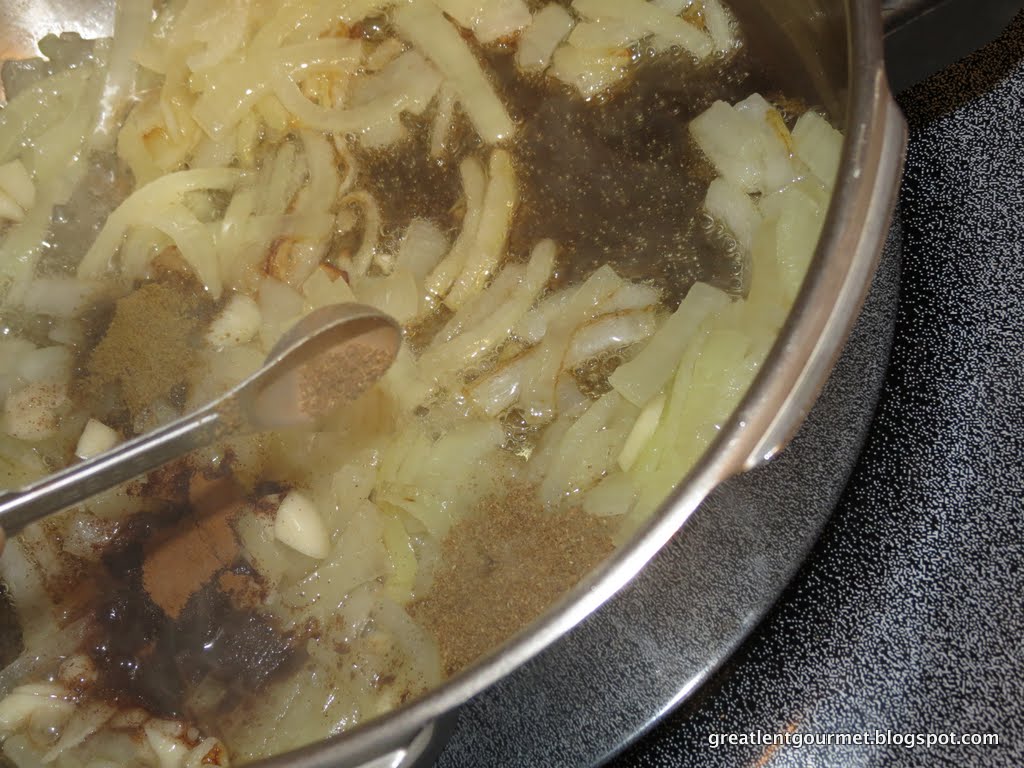
Now, add the spices of cinnamon, coriander, and cumin.  Wow!  You will have an amazing smell wafting through the kitchen.  Make sure the onions get fully coated with these spices.  You will see the onions turn a bit brown from the spices, but that's okay.  Just keep mixing so nothing sticks to the bottom of the pan.


Next, you have to rinse the eggplant under cold water.  Keep the water running while you move the colander around; you want to make sure to remove as much of the salt and drippings as you can.   After the eggplant is well rinsed, we will add the eggplant to the onion mixture and mix it well, too, making sure that the eggplant is fully coated with the spices.  Let this cook for about 10 minutes, until the eggplant is soft.


Then, drain the chickpeas and rinse them well under running water.  You don't want any of the canning liquid flavour coming through, so you have to wash them well.  Then, add the chickpeas to the pot.  Also, add the can of tomatoes - juice and all!  Add the entire contents of the can.  Mix all of the contents of the pot together so that the onions, the spices, and the tomatoes are evenly distributed in the pan.


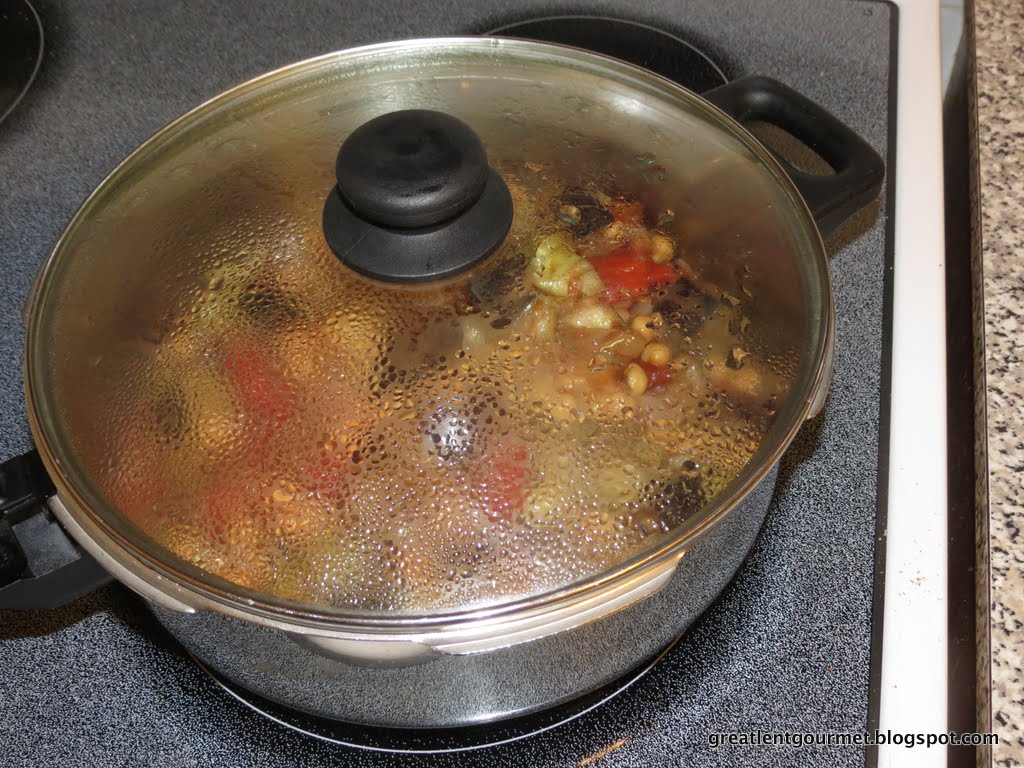
Now, cover the pot and allow this to simmer on a medium-low heat for about 20 to 30 minutes.  Make sure the eggplant is cooked all the way through and that the chickpeas have softened.  You will notice that there may be more liquid in the pot than when you started.  That's fine since the vegetables have released their own juices.  Also, this gives you one more reason to make a nice rice, quinoa, or pasta to soak up all those extra juices.  Serve this warm and enjoy.

We are thrilled to have tried this recipe.  It was a first for us.  Since neither of our families are from northern Greece (all of my ancestors are Greek islanders while my husband's are from Peloponnesos), we were intrigued at the spice combination and that is what enticed us about this dish originally.  Now that we have made this, we  know it is an easy meal to serve through Great Lent and we would use it as a side dish in the summer when eggplants are in season.  It was filling without being too heavy, and it has so many nice flavours coming through.  The cinnamon made the whole house smell good, and the coriander and cumin gave the dish an interesting twist.  Who knows?  We may have to actually try other recipe from this book instead of just reading and looking at the pictures!


"As salt is needed for all kinds of food, so humility is 
needed for all kinds of virtues."

St. Isaac the Syrian