Showing posts with label sweet. Show all posts

Sunday, 7 April 2013

Day 20: Savoury Vegan Tomato Potatoes with Onions and Cinnamon - April 6, 2013


Potatoes are a staple food for the Greek diet.  Even if there is rice on the table, we may still offer potatoes also.  There are so many ways to prepare potatoes, that sometimes, it is hard to decide which method to use.  We often roast the potatoes with lemon and oregano, but today we wanted something a little different; so we decided to use a tomato sauce as the backdrop of this potato dish.

 The tomato sauce with the potatoes will make just the right side dish for our family today.  We like kokkinisto (foods in a smooth tomato sauce) and we like yiahni (foods in a chunky tomato sauce), so why not tomato sauce on potatoes?

This will take about 15 minutes to assemble, and takes about one hour in the oven.  If this is your choice as a side dish, then you can get it in the oven while you prepare something else.  It is that simple, and needs little attention.


For this recipe, you will need:

about 6 large potatoes, peeled and cut into wedges
1/2 cup or so of tomato sauce
some water
4 TBSP oil
salt and cinnamon to taste
1 onion, chopped


Our first thing to mention is that we did not have large potatoes today.  But this recipe, as with any kind of oven-roasted potatoes can be made with large, small, or any size of potatoes. For today's dish we had small new potatoes available to us to use.


Cut the potatoes, preferably into wedges.  We did not peel ours because they are small new potatoes with a very thin skin.  Let's also not forget that the skin has many nutrients!  We did, however, wash the potatoes well.  And, we also chose to cut them into halves since they were so small in the first place.  Put the potato pieces in a large mixing bowl.


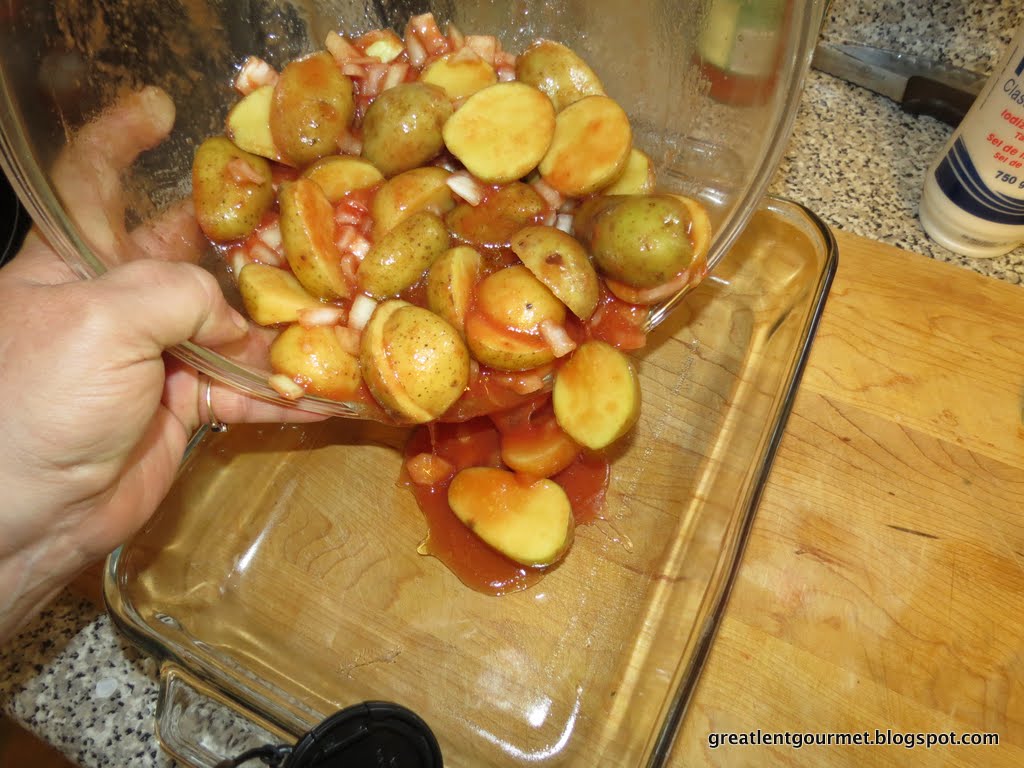
Now, in that bowl, add the chopped onions, tomato sauce, salt and cinnamon.  You want to add everything to the bowl except the water and oil. Keep that for a later step.  Mix well to ensure that all  the potatoes are coated well with the tomato and spices.


Now, add some olive oil.  We add enough to circle the bowl two times.  It seems like enough oil to lightly coat the potatoes, but not enough to saturate the tomato sauce with oil.


Now, add some water.  You need about 1/2 cup or so (about 125 mL), but will need to add more before putting it in the oven (see next step).  Mix well so all the potatoes are evenly coated and covered with sauce.


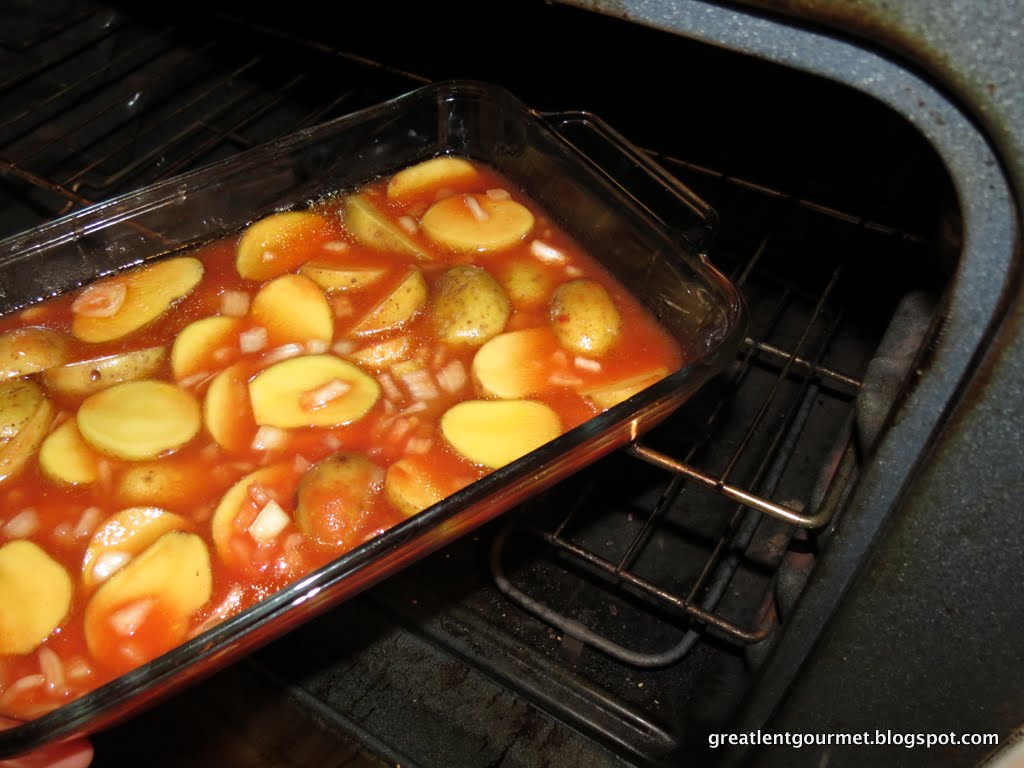
Once it is all mixed well,  pour this into a glass baking dish.  Add more water until the water level in the baking dish just covers the top of most of the potatoes.  It is okay for some of the potatoes to stick out.  Remember, if you add too much water, the potatoes will be soggy and wet when they are cooked.  If you don't add enough, the potatoes will not have that creamy yum that they usually get in the oven.  Make sure that everything is well distributed in the baking dish.


Bake at 350° F (about 175° C) for about 1 hour until the potatoes are soft and the colour on top is a golden baked colour and the water has mostly evaporated.  You want to make sure there is still some liquid in the potatoes, and you may need to add water through the baking process to make sure there is enough.  If you find that there is not enough, then add a little boiling water at the end and mix carefully before serving.  Serve these potatoes hot and enjoy.


We liked these potatoes a lot.  They were easy enough to make and even easier to eat.  The creaminess of the potatoes really balanced the tanginess of the tomato sauce.  The one adjustment we would make for the next time is to add a little more cinnamon.  There was just the slightest hint of cinnamon, but we wanted more, so we would increase from a pinch of cinnamon to a full teaspoon or two.  We also may cut the onions in a different shape for variety.  Sliced onions would look more appealing on the dish, so we will consider that adjustment, also.  Overall, this was a great addition to our meal.  We would not hesitate to make this again and again, and we believe that this recipe will be well received by most people (unless you don't like cinnamon with a savoury dish).  In fact, we liked it so much that members of our family suggested that we make it again for Easter Sunday with our lamb dishes.

"Pray as though everything depended on God. Work as if everything depended on you."

St. Augustine

Monday, 25 March 2013

Day 7: Γλυκό Του Κουταλιού Με Σταφύλια και Αμύγδαλα - Greek Spoon Sweet with Grapes and Almond, March 24, 2013


Γλυκό του κουταλιού is a household phrase, and it always refers to a delightful treat that is offered to unexpected company.  It is served with a glass of cold water, and it is a simple pleasure in the Greek
home. Here in North America, we may know it as 'spoon sweets', which has several interpretations. For us, a spoon sweet should be self-explanatory -- a sweet eaten with a spoon. That is a huge category of foods. Spoon sweets are specifically a caramelised, drippy, sweet, fruity, nutty delight, that takes only two spoonfuls to fill any sweet tooth. So, today, we created one from grapes. Γλυκό σταφύλια με αμύγδαλα is sweet grapes with almonds.

Many homemakers have their own way of making γλυκό, and use a variety of fruits or nuts to do so. Grapes are a popular choice because of the plentiful amounts available all year. The recipe is basic, and can be used with any fruit. We have made this with watermelon rind, almonds, quince, grapes, and orange peels. Our favourite, by far, is the grape. There is something about the sweet squish of the fruit in your mouth, when coated with a lovely caramel-like syrup. And, adding the almonds gives another dimension to the texture, by adding that lovely crunchiness. Here is what we did to make γλυκό του κουταλιού:


You will need:
1 pound of grapes, washed and stemmed
1 cup water
2 cups granulated sugar
juice of 1 lemon
1/2 cup slivered or sliced almonds


First, toast the almonds. This can be done in the oven, but we found that the frying pan was fast and easy in order to see the colour and that the almonds did not burn. Toast the almonds long enough that at least half of them are golden brown. Set these aside so they are cool when you add them to the glyko.


Put the grapes in a pot.  Do NOT add anything to the pot -- just grapes.  When you turn on the burner, you are cooking the grapes and making all the juice run into the centre.  It is like warming a lemon before juicing -- you want more flavour so you heat it.  Heat the grapes.


The grapes start to change colour and you see them turning a more whitish-yellow tint.  This indicates that those grapes are ready.  Continue to heat the grapes until they are all that same colour.

Next, add the sugar and the water.  Make sure the grapes are all coated with the sugar before adding the water.  Then, when you add the water, mix well so the sugar all dissolves.  The ratio for sugar to water is 2:1, and should be the same if you make more than one pound of grapes.  Interestingly, the ratio of grapes to sugar is also 2:1, and if you remember these two ratios  you always will remember the recipe!


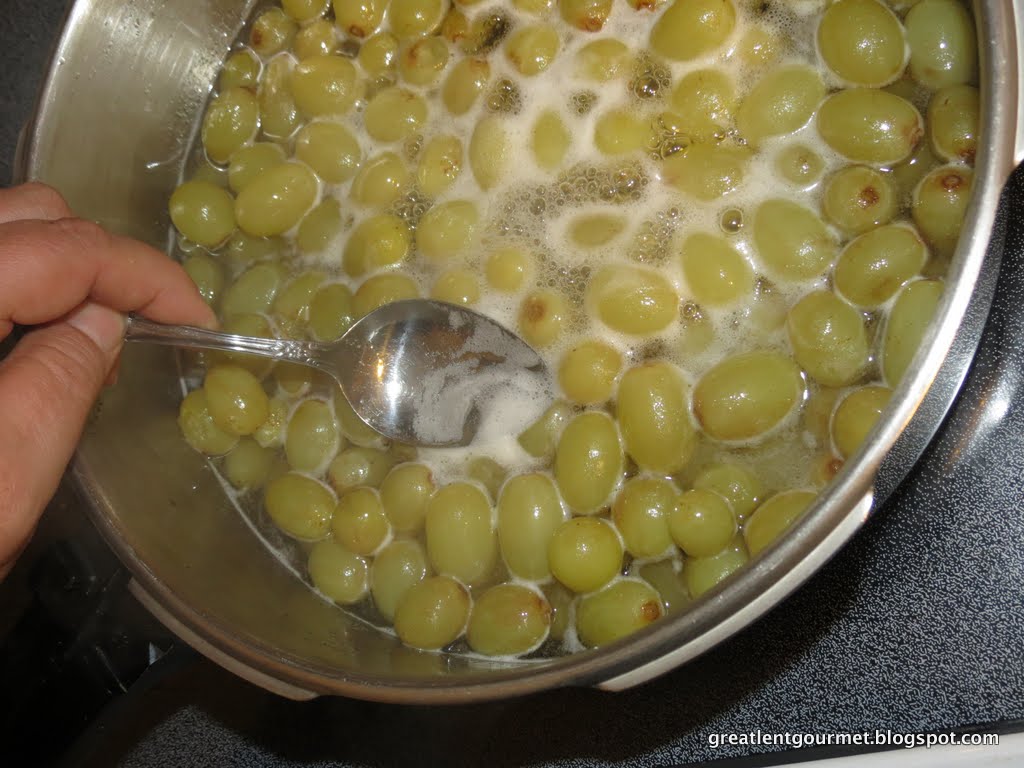
As this mixture begins to boil, you will need to remove any foam that surfaces.  Using a spoon, carefully scrape the foam layer off the top of the syrup.


As the mixture cooks and the syrup thickens, you will see the change of colour in the liquid.  That means that the sugar is beginning to caramelise.  You will then have to watch closely, turn the heat down, and let this cook uncovered, on low heat, until the syrup thickens.  This will take about 30 minutes, depending on your stove.


Then, add the lemon juice and the nuts.  Stir well so that the nuts and the grapes are evenly distributed in the syrup.  Let this cool completely before serving.


Some people will add vanilla flavouring to the mixture, or use rose water instead of lemon juice. That's the beauty of a recipe like this -- everyone has the same basic recipe but adds a little something to make it their own. For us, we like the tartness of the lemon mixed with the sweetness of the syrup. And since γλυκό του κουταλιού is typically served with a glass of cold water, the lemon and sugar stays on the tongue to make the water taste better, too. Γλυκό του κουταλιού is a sweet, drippy treat that takes a little time to make, but is worth it in the end.


YouTube video:  The Sunday of Orthodoxy (Source: https://www.youtube.com/watch?v=YZB56qkfzJM)