Sunday, 7 April 2013

Day 21: Strict Vegan Monastery Soup with Orzo and Tahini - April 7, 2013


The monks have taught us quite a bit about food.  There have been many recipes that we have tried and liked.  Each time that we read a Lenten cookbook of any kind, we keep running across a recipe for Monastery Soup.  Each recipe is just a shade different, but all are essentially the same basic soup.  They all have the same 5 ingredients, but the method may differ a little.  After reading many of these recipes, it was time to try our hands at making this strict fast food.  Husband warned me in advance of making this blog entry that it may be too mild a soup for some of our readers.  After trying the final product, however, he understood that this Monastery Soup WILL appeal to people who do want a very simple, quick to make and inexpensive nutritious staple dish.


For this recipe, you will need:

4 cups water
2 teaspoons salt
1/2 cup rice or orzo
1/2 cup tahini
4 TBSP lemon juice


We want to mention the rice or orzo choice.  Rice in a soup is inexpensive and easy.  Most people have some form of rice in the pantry.  And, with rice you know the soup is done cooking when the rice is soft.  But, we chose to add orzo instead of rice.  Orzo is known as manestra (μανέστρα) in Greek.  It is found in most  major grocery stores as well as Greek or Italian speciality stores.  Orzo is a form of pasta, made with semolina flour and water, and it swells to double in size when it is cooked.   We have used manestra in so many dishes, and we love pasta, so why not choose that over ordinary rice?  We did.


Now, to make this soup, you start by boiling water.  Add the orzo or rice to the water and boil until the pasta is cooked.  Then, turn down the heat and allow the soup to simmer.


 In a separate bowl, beat the tahini with one ladle full of the pasta water.  Mix well to make sure the tahini fully dissolves.  This will look like miso soup at first, but keep mixing.  Add a little more pasta cooking water, as needed, to dissolve all of the tahini.


Now, add the tahini mixture to the pot.  Mix this well and season it with salt and lemon juice. Then, when you get the seasonings right, serve the soup.  We found that if you let it sit for a while, the soup gets much thicker and takes on the consistency of an avgolemono soup (αυγολέμονο / egg-lemon).  And, when you reheat the soup, the thickness remains and the flavours start to meld together.

That's it.  Making soup is only easier if you open a can!

The monastery soup is a fascinating because of its absolute simplicity.  There are variations that do not include orzo or rice, and it is just the broth.  It reminds us of miso paste -- just add hot water and you have a lovely, very mild and flavourful broth.  There are a lot of things you can add to make it more flavourful broth, including veggies, beans, and seafood, and then you would have a very hardy soup that you can call your very own.  We do appreciate the monks and their dedication.  And, we appreciate them sharing their soup with us.

"Riches are not forbiden, but the pride because of them is."

St. John Chrysostom


Day 20: Savoury Vegan Tomato Potatoes with Onions and Cinnamon - April 6, 2013


Potatoes are a staple food for the Greek diet.  Even if there is rice on the table, we may still offer potatoes also.  There are so many ways to prepare potatoes, that sometimes, it is hard to decide which method to use.  We often roast the potatoes with lemon and oregano, but today we wanted something a little different; so we decided to use a tomato sauce as the backdrop of this potato dish.

 The tomato sauce with the potatoes will make just the right side dish for our family today.  We like kokkinisto (foods in a smooth tomato sauce) and we like yiahni (foods in a chunky tomato sauce), so why not tomato sauce on potatoes?

This will take about 15 minutes to assemble, and takes about one hour in the oven.  If this is your choice as a side dish, then you can get it in the oven while you prepare something else.  It is that simple, and needs little attention.


For this recipe, you will need:

about 6 large potatoes, peeled and cut into wedges
1/2 cup or so of tomato sauce
some water
4 TBSP oil
salt and cinnamon to taste
1 onion, chopped


Our first thing to mention is that we did not have large potatoes today.  But this recipe, as with any kind of oven-roasted potatoes can be made with large, small, or any size of potatoes. For today's dish we had small new potatoes available to us to use.


Cut the potatoes, preferably into wedges.  We did not peel ours because they are small new potatoes with a very thin skin.  Let's also not forget that the skin has many nutrients!  We did, however, wash the potatoes well.  And, we also chose to cut them into halves since they were so small in the first place.  Put the potato pieces in a large mixing bowl.


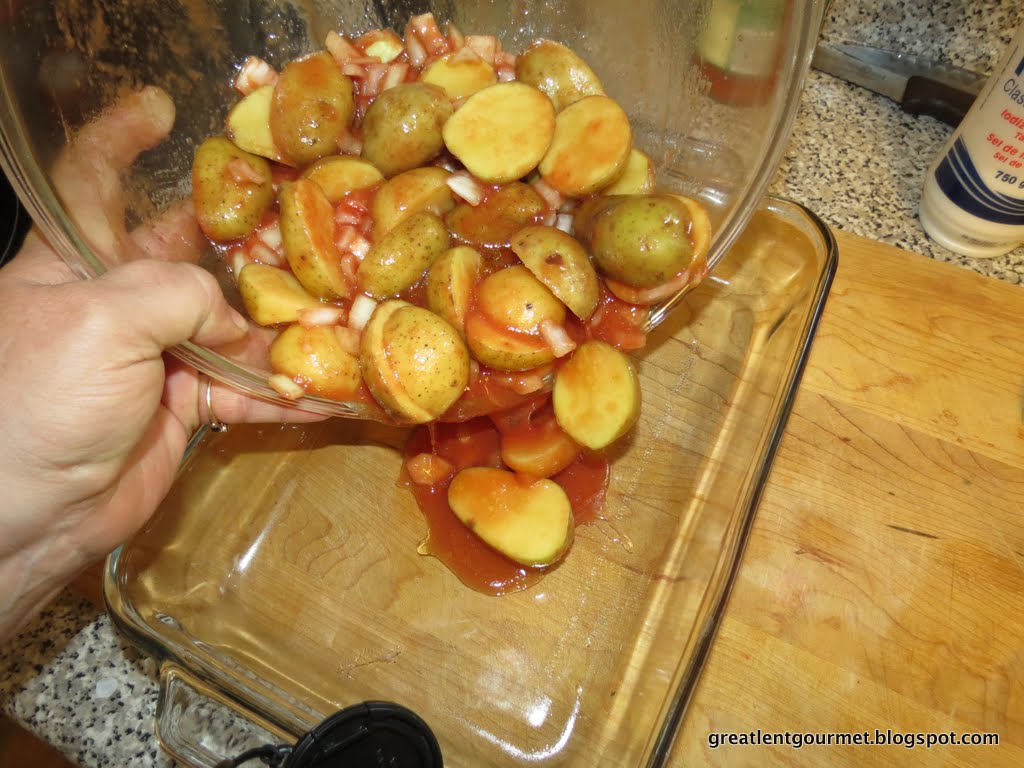
Now, in that bowl, add the chopped onions, tomato sauce, salt and cinnamon.  You want to add everything to the bowl except the water and oil. Keep that for a later step.  Mix well to ensure that all  the potatoes are coated well with the tomato and spices.


Now, add some olive oil.  We add enough to circle the bowl two times.  It seems like enough oil to lightly coat the potatoes, but not enough to saturate the tomato sauce with oil.


Now, add some water.  You need about 1/2 cup or so (about 125 mL), but will need to add more before putting it in the oven (see next step).  Mix well so all the potatoes are evenly coated and covered with sauce.


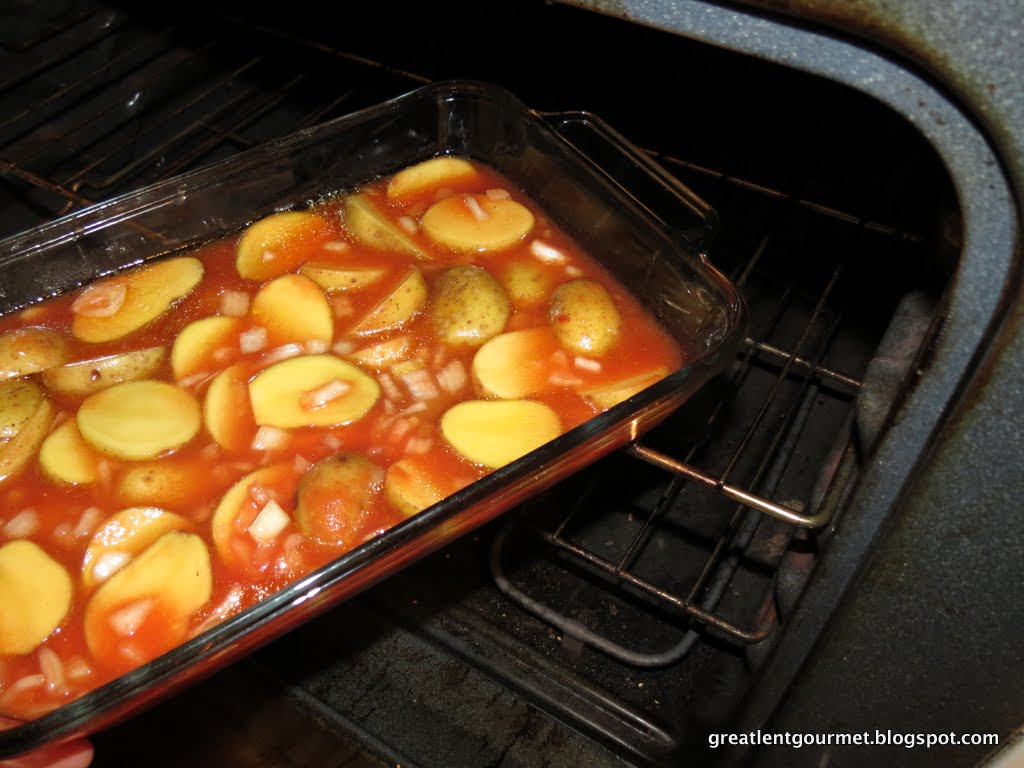
Once it is all mixed well,  pour this into a glass baking dish.  Add more water until the water level in the baking dish just covers the top of most of the potatoes.  It is okay for some of the potatoes to stick out.  Remember, if you add too much water, the potatoes will be soggy and wet when they are cooked.  If you don't add enough, the potatoes will not have that creamy yum that they usually get in the oven.  Make sure that everything is well distributed in the baking dish.


Bake at 350° F (about 175° C) for about 1 hour until the potatoes are soft and the colour on top is a golden baked colour and the water has mostly evaporated.  You want to make sure there is still some liquid in the potatoes, and you may need to add water through the baking process to make sure there is enough.  If you find that there is not enough, then add a little boiling water at the end and mix carefully before serving.  Serve these potatoes hot and enjoy.


We liked these potatoes a lot.  They were easy enough to make and even easier to eat.  The creaminess of the potatoes really balanced the tanginess of the tomato sauce.  The one adjustment we would make for the next time is to add a little more cinnamon.  There was just the slightest hint of cinnamon, but we wanted more, so we would increase from a pinch of cinnamon to a full teaspoon or two.  We also may cut the onions in a different shape for variety.  Sliced onions would look more appealing on the dish, so we will consider that adjustment, also.  Overall, this was a great addition to our meal.  We would not hesitate to make this again and again, and we believe that this recipe will be well received by most people (unless you don't like cinnamon with a savoury dish).  In fact, we liked it so much that members of our family suggested that we make it again for Easter Sunday with our lamb dishes.

"Pray as though everything depended on God. Work as if everything depended on you."

St. Augustine

Friday, 5 April 2013

Day 19: Vegan Sweet Potato Skordalia, April 5, 2013


When we think about skordalia, our first thought is usually garlic.  Our second thought may be the  food that we serve with skordalia, or even the potatoes.  We did not think about sweet potatoes, however.  Yes, sweet potatoes!  The beautiful orange tubers that melt in our mouths with a little butter and brown sugar do not seem, at first,  to go with garlic.  But, the authors of The Olive and the Caper offered a simple recipe for sweet potato skordalia, that we became intrigued and had to try it.

The authors of the book write about the importation of potatoes into Greece, and how sweet potatoes are still a new food in Greek cuisine.  But, finding a place for the sweet potato may be difficult, since many classic dishes use potatoes which are savoury and have a tomato base; sweet potatoes may not fit into some of those recipes.  Using them with garlic and vinegar seemed out of place to have that sweet, creamy base with the bite of the garlic and the tang of the vinegar.

But, if a Greek household such as ours is to learn about how to use sweet potatoes in traditional fare, then this is a good place to have our first lesson.  Our other thought was that during Great Lent, we make skordalia regularly; we tried the walnut one, so why not try this suggestion, too?  This very informative cookbook has given us some really great recipes and stories, so we had some faith that this would turn out well, too.  And, we only had to buy sweet potatoes -- we had all the other ingredients.


For this recipe, you will need:
2 medium sweet potatoes
1/3 cup pine nuts (can use almonds as a substitute)
3 large cloves of garlic
1 cup olive oil
1 Tablespoon red wine vinegar
1/4 teaspoon salt
dash of cayenne pepper (or other hot pepper)
1/2 cup water
and a food processor


The first step to this recipe is to peel the sweet potatoes, then cut them into cubes. You want to cut them into similar sized cubes so that they cook at the same rate while boiling.  Uniformity is important in a lot of foods for this reason, so make sure they are similarly sized chunks of potato.  Put the sweet potato cubes into a pot full of water, and boil until they are just tender.  If a fork is put into the piece of potato, and the potato slides off the fork then it is done cooking.  You want to make sure there is a very slight bite to the potato and it is not mushy.


While the potatoes are cooking, start mixing together the pine nuts and the garlic in the food processor.  Give this a few pulses so that the two mix together well.  The pine nuts do not have to be well-pureed here, because they will continue being smashed when adding other ingredients.


Next, add the oil and the vinegar to the food processor.  Add the cayenne pepper, too.  Remember that cayenne pepper, as do many hot peppers, get a little hotter as they sit, so don't go too crazy with the spicy.  The bite of skordalia should come from the garlic, not the hot pepper.

Beat the ingredients together until you have a smooth and creamy mixture.  It will look a little like Hollandaise sauce or mayonnaise when it is all whipped.  But, we are not done yet.  So, this is the point to make sure that the nuts, garlic, oil, and vinegar are smooth and creamy.


now it is time to add the sweet potatoes to the food processor.  But, first, take them out of the boiling water and drain them in a colander.  Give them a moment to cool, or, run them under cold water to stop the cooking process.  Drain all the water you can off of the sweet potatoes, and then, add them to the nut/oil mixture.


Use the pulse function on the food processor to get to a chunky consistency.  If you want the final product to be chunky, then add only half to two thirds the amount of sweet potatoes initially, and reserve the remaining sweet potatoes for the adding at the end.  If you prefer a smooth and creamy texture, then continue to blend until you reach the desired consistency.


But, you are not done yet!  Now, with the lid on, and using the lowest speed setting on the processor, begin pouring in the water to the mixture until it is all blended well.  This will make the sweet potato skordalia a little fluffy and add the last bit of creaminess to this dairy free delight.


Whip this until you achieve the smooth, creamy consistency of a dip or a spread.  If you chose to withhold some of the sweet potatoes to get to a chunky version of skordalia, then add them after the water and continue with only the pulse function in order to get to the consistency you want.  Then, when you are done blending, chill the mixture until you are ready to serve it.  Put it in a serving dish and garnish as you would any skordalia -- with capers, crushed pepper flaks, oil, pine nuts or just parsley.  Now, you can enjoy the sweet potato skordalia!


Prior to making this dish, we were not sure what we would think about this skordalia.  As much as the recipe appeared interesting, and given the fact that we really like this cookbook, this was so different from the traditional versions that we don't know what to expect.

So, what is the verdict? It is an unexpected surprise to get the sweetness of the sweet potato, followed by the little bite of garlic.  The pine nuts were completely unnoticeable in this.  We think that they were used more as a binding agent than a flavouring.  Almonds may have gone better for flavour in this.  We garnished with a little oil and a sprinkling of hot pepper just to keep it simple.  That extra bite of hot pepper was nice, but did not really match the expectation of sweet that we wanted from the sweet potatoes.   Actually, we all thought the recipe needed a little more red wine vinegar.  We all agreed that it was a lovely texture, spreading so easily and smoothly onto our crackers and bread.  We even used it as a sandwich spread with lettuce, tomato, and onion. That was interesting!  Somehow the sweet potato really worked with the onion and tomato -- the lettuce was just for the crunch.  We also used it with some roasted vegetables and that seemed to be the best combination.  The sweet roasted peppers and zucchini were perfect matches with this sweet potato creation.  The pairing just 'worked.'

We don't know that we would make this too often, but it is a nice surprising dish that combines flavours in a new way.  It is worth trying, and worth using as a treat.  Now, we have yet one more way of making skordalia, and that is always a bonus!


"Many a man curses the rain that falls upon his head and knows not that it brings the abundance to drive away the hunger."

St. Basil the Great