Wednesday, 5 March 2014

Day 3: Papa's Savoury Baked Eggplant with Chopped Garlic, Ψητές Μελιντζάνες με Σκόρδο, March 5, 2014


On Kathara Deftera's Koulouma meal (Day 2 of this year's blog) we had a variety of foods on our table. Most of them were without oil (no olive oil in any items with a couple of items having canola oil). Most importantly, all of them were fasting appropriate by not having any animal products with blood. One of the dishes that we had, and one which we enjoy regularly is the creation of a senior family member, the 87 year old grandfather (παππού) in our family. He makes these whenever he can, and we all benefit from that! This dish is simple to prepare, and even easier to eat! We are talking about the aubergine - eggplant.

Eggplants are part of the nightshade family, as are potatoes, tomatoes, peppers, and belladonna. Some members of this family can be poisonous because of the narcotic traits, but eggplant is not one of them. In fact, the eggplant has plenty of health benefits by giving us fibre, vitamins B, C, and folate, as well as minerals like potassium, magnesium, and calcium. They come in a variety of shapes, sizes, colours, and flavours. In previous posts, we have noted the Chinese eggplant as one of our favourite kinds because it does not have a bitter aftertaste that many of the larger, Italian varieties do. The long, slim eggplant also has a tender skin that you can leave intact for cooking. In today's marketplace, it is easy to find the Chinese variety, but you should always use the ones you like the best. Whichever variety you choose, make sure to look for a firm, smooth vegetable with no bruises, soft spots, or blemishes on the skin.

This recipe is a homemade one, therefore, we don't have exact measurements. But, we do have the method, and you can adjust the seasonings to your preference. It has only four ingredients and takes about 30 minutes to prepare. Knowing this, you can add it as a side dish to any meal, even the ones that have meat!

First, wash the eggplants and remove the top stem part. This part is inedible anyway, and it is probably not yummy. When you cut off the stem, try to cut as close to the fruit as possible. For us, it is important to get as much of the fruit as we can.


Now, we slice the eggplants lengthwise. While this member of the family slices in his hand, like many people, he gets the feel of the eggplant to follow the curves, and stay steady as he slices. The goal is to achieve even slices.


Now, lay all the eggplant slices in a pan or a bowl -- whatever container will hold the slices and you have enough room to mix them with your hands.


Once all of the slices of eggplant are in the pan, pour some vegetable oil over the batch. We don't have an exact measurement, but pour enough oil to cover the top, and then make sure that it is enough to coat all of the under layers of eggplant slices. Then, take a handful of salt and sprinkle it all over the eggplant slices. This may look like a lot of salt, but it is typical with eggplant to use salt to draw out some of the liquid and to remove any residual bitterness. You can adjust the salt to your personal preferences.

Add the salt and then mix the eggplant slices very well. You want to make sure that each slice is coated with oil and salt, so you may have to move the slices from the bottom to the top and all around the pan to coat them evenly.


Lay the eggplant slices on a cookie tray that is lined with parchment paper. The paper will prevent the eggplant from sticking to the pan. Even though there is oil on each slice, there is some sticking if you eliminate the paper. We have tried before to use a silicone sheet liner, but the paper works better. Line up the slices in a single layer on the cookie tray. You can see the beautiful shine!


Put the eggplant in the preheated broiler at the highest setting (top rack) for 10 - 15 minutes (depending on your oven). You will see a lovely brown colour develop on the top of the eggplant. Try to leave the eggplant in the broiler for enough time to develop this full, rich colour.


Then, turn over each slice of eggplant, and put it back into the broiler for another 10 - 15 minutes. Once again, you will see the beautiful brown colour develop and you may want to feel the eggplant slices in the middle to feel if the middle is soft. This is a very good indication that the eggplant is cooked through and ready to eat.


Remove the eggplant slices from the cookie tray, and put them into either a plate for serving, or a container for storing. This time we used a plate, because they were part of our dinner. However, in the past, παππού has put them directly into a glass storage container (a 2 quart or 2 litre Pyrex dish) for future consumption. Try to transfer the eggplant slices while they are still warm, so not to overcook them, because the eggplant will become mushy when overcooked.


Then, take a few cloves of chopped garlic and sprinkle that all around the dish. We used fresh, chopped garlic instead of any garlic powder or processed chopped garlic. The processed chopped garlic does not always give the bite and sharp flavour of fresh garlic. And, garlic powder can turn into paste when mixed with oil, so you want to avoid that. And, if you ask the family member who made this dish, he will tell you, "Garlic is good for your health. You should eat it with everything!" And, we agree -- well, almost everything!


Finally, pour vegetable oil over the warm eggplants, enough to coat the top of the heap of eggplant slices. The oil will get mixed around, and there will be some oil coming out of the eggplant from the baking process. So, pour enough to coat the top of the slices, but not enough to make the eggplants soaked with oil. If you are making these to store, and use at a later time, then cover the eggplant completely with oil, so they are preserved for the refrigeration.


At this point, you are ready to serve your eggplant dish. It is ready for the table and will add another inexpensive, tasty and nutritious alternative to your choices of Lenten side dishes or snacks.


Source of image: http://orthodoxchurchquotes.com/2013/10/27/st-mark-the-ascetic-wickedness-is-an-intricate-net/

“Wickedness is an intricate net; and if someone is careless when partially entangled, he gets completely enmeshed.” – St. Mark the Ascetic

Tuesday, 4 March 2014

Day 2: Koulouma, Κούλουμα 2014, March 4, 2014


Clean Monday, Kathara Deftera was yesterday.  We had our traditional Koulouma with the family, and a few members of the extended family, too.  There were so many choices about what we should make to eat, but there was never a question that we would have a lovely evening of family time.  It gives us an opportunity, as a family, to give thanks, ask for forgiveness, and share in a communion of a sort.

Yesterday, we took you through one of the grocery stores that we frequent, partly because it offers many of our Greek specialty items, but also because of the variety of produce available there.  We showed you some of the beautiful choices of foods before preparation.  Now, we want to share with you some of the prepared items.  Although we did not get step by step pictures of how to make everything for yesterday, it is likely that you may see how to prepare these foods over the next seven weeks.  Some of our prepared items:


Our Koulouma was more or less traditional, offering a variety of dishes, some light and some more substantial.  One of the main dishes that we offered was the marinated octopus.  It had a light coating of canola oil, salt, pepper, and oregano.  The octopus was so tender from being boiled to perfection -- like eating velvet.  The subtle seasonings made it taste fresh and delightful.


The boiled potatoes were half white potatoes, and the other half were sweet potatoes.  We sprinkled some parsley on top of the cooked potatoes to add some colour.  The flavour and the creaminess really made these potatoes shine, without needing to add more than the garnish.


One of the family members brought dolmades (stuffed grape vine leaves).  Of course, they had a rice filling with no meat.  They were coated with a blend of vegetable oil and lemon, and were a nice addition to our menu.  It is nice when relatives come and contribute something yummy! We weren't sure, but the firmness of the rice led us to suspect that these dolmades may have come from a can. Normally, we prefer home-made ones but these were quite tasty.


A dish which is a nice filler for several types of meals is a plate of pickled vegetables (toursi).  Our plate had (from left to right) homemade green tomato pickles, shredded sun dried tomatoes, roasted yellow Greek bell peppers, Lebanese pickled baby wild cucumbers, and pickled Greek roasted red peppers.  This was a combination of sour pickles and sweet roasted vegetable that most members of the family enjoyed.  Once again, we regularly enjoy adding pickles of all sorts to our dinner table.


We also had a nice assortment of olives.  On the left, there are olives stuffed with garlic, ones stuffed with pimentos, salad olives, red pepper strips and pearl onions.   On the right are olives that we bought at the grocery store that are pickled and spiced with red pepper flakes (known as μπούκουβο or boukouvo in Greek). They surely added a kick to the meal!  You would have to like spicy foods in order to like these (hot and spicy) olives.


And, we cannot forget the lagana (laganes)!  This year, one family member who was out in the stores, and stopped at a meat market/butcher's shop to find lagana for the family.  It sounds a little odd, but the butcher shop has a bakery attached to it.  He said there were at least 400 people waiting in line to get loaves of lagana (we're not sure if that's an accurate number but it did sound dramatically high).  Every 20 minutes, loaves came out of the oven and they were gone!                                                                                


Fruit and nuts are always part of a traditional Greek meal.  Why would Kathara Deftenra be any different?  We had an assortment of fruit, with some dried Kalamata figs, and unsalted cashews.  The nuts seemed to complement the end of the meal with the halva as "dessert."  We ended on a sweet note from the food, and from the family.  May this Lenten season bring sweetness to your lives, too.


Source of image: (click here)

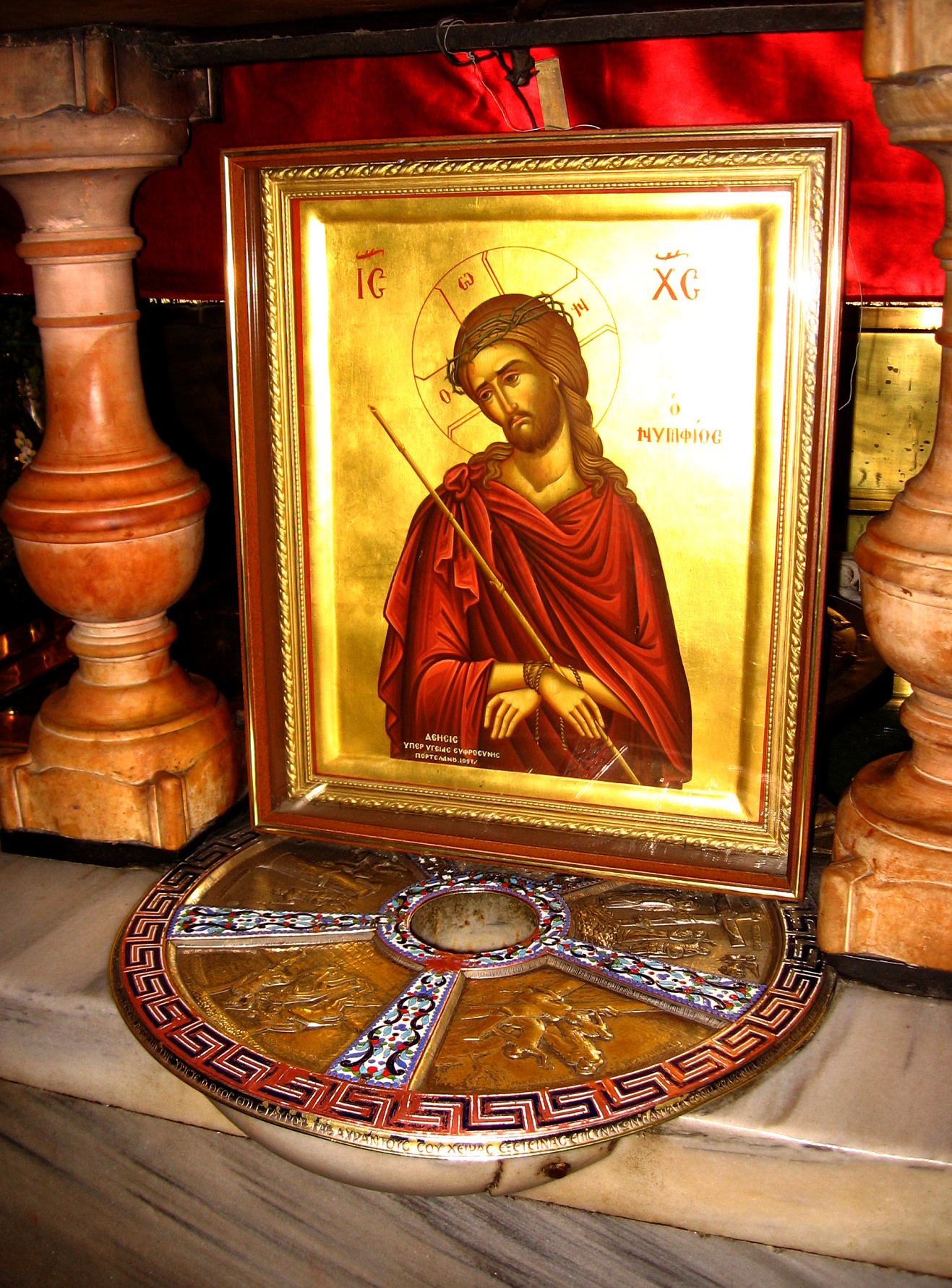
Description: "Under the Eastern Orthodox altar on Calvary (Golgotha) (now on the right after the main entrance in the Church of the Holy Sepulchre, Jerusalem) there is the place where it is believed Jesus died on the cross."

This is a file from the Wikimedia Commons. Information from its description page there is shown below.

Commons is a freely licensed media file repository. You can help.

Monday, 3 March 2014

Day 1: Clean Monday, Καθαρά Δευτέρα, March 3, 2014


Welcome back to Great Lent Gourmet!

It is with great excitement and anticipation that we have been waiting to restart our annual tradition of writing for our humble blog about fasting and prayer over the duration of the Easter Lent, also known as Great Lent. We have been encouraged by the outpouring of support from people from all corners of the world, Greek and non-Greek, Christian and non-Christian, Orthodox and non-Orthodox Christians alike.

This year we realized that there were so many steps to take in order to get ready for our Koulouma.  It is known that Clean Monday refers to clean living, such as clean eating, clean mind, clean hearts, and also clean house.  This was traditionally the day for spring cleaning.  Once the house is clean and the table is set for the family and guests, we then begin our actual preparations for the meal.  Although one goal of Great Lent is self-control, Kathara Deftera is a day of celebrating the Great Fast.  So we thought we would take you through some of our preparations. It must be noted that the origin of the term "Koulouma" has been debated for awhile; the well known Aglaia Kremenzi has recently provided an interesting historical theory as to the origin of the term (see here for her explanation).

Our first job is to check our pantry to see what is available on hand already that would meet the requirements of Kathara Deutera -- that is, no meat (no blood!), no dairy, no cheese, no butter, no whey, no gelatin, no eggs, and no olive oil.  As we read labels and lists of ingredients, the choices become increasingly more clear that we must stick to simple foods, vegetables, fruits, and, of course, lagana bread (see last year's entry on lagana).


There are several choices already stocked in our pantry because our regular diet choices often revolve around Greek foods and since we do our best to maintain the fasting schedule of the church throughout the year, we have on hand various types of pickles and olives that will complete any table setting.  This year  we are delighted to have our own homemade green tomato pickles that we made in August.  As for the olives, we will have to choose the right varieties (for example, for today we chose not to include the California green olives marinated in wine and olive oil).

So, what else could we put on the table with our pickles, olives and lagana?  Well, the answer is found by walking through the grocery store and letting your taste buds guide you.  As we tour our neighbourhood market (Sun Valley, Toronto), we stay around the perimeter of the store which gives us an amazing view of fruits, nuts, vegetables, potatoes, and breads. It is true that we pass the butcher counter and the deli, but that takes us to the breads and desserts.  We are very fortunate to have a market that carries many of the Greek foods that we have become accustomed to having for our Koulouma.  With so many choices, how to you narrow it down?

We start with the selection of fruits.  We are now in March; only a few fruits are genuinely in season, while other, non seasonal fruits are equally available and attractive.  We know that citrus fruits (oranges, mandarins and grapefruits) are at the end of their season, but still quite tasty right now.  Globe grapes seem to be appealing with their size and firmness, so they may be a choice.  However, pineapples have come into their peak season, as have mangos, so they should be considered.  Any fruit is a good choice for tonight and would definitely add nice colour to the table.  In fact, fruit is a good addition to any meal, any time of the year. We will also choose a variety of nuts to accompany the fruits.


The next section of the store hosts the vegetables which are more abundant than the fruit, making it almost harder to choose!  With so many choices it is hard to know what is really in season.  In March, commonly seen are broccoli, cauliflower, asparagus, beets, avocados, Brussels sprouts, and carrots… and the list just goes on!  Narrowing the choices becomes increasingly difficult, but we decide on a handful of colourful vegetables that will be flavourful raw or steamed.  And anything that can be steamed and enhanced with a squeeze of lemon goes up the list of choices to the top!  As we choose our asparagus, a head of lettuce, some tomatoes (even though they are not in peak season), we think about the colours and variety of shapes that will adorn our table.  And, we think about the beauty and simplicity of the foods we are choosing.


Now, we walk a little more toward the deli counter. We are not there to buy our typical shopping list of salami and cheese, but to choose our varieties of halva, maybe a little taramasalata (although we prefer our homemade version, time was short), and even consider some pickled octopus.  The Lenten choices are abundant, and there are several varieties of olives, too!  Well, we settle on one or two deli counter items, choose our halva, and walk away to avoid any temptations.


As we  walk away from the deli, we round the corner of the store and land in the middle of the bread section.  This is where the grocery at which you shop really matters.  As we continually  mention, we are fortunate to have a Greek and Italian owned grocery that stocks many Greek specialty items.  They have a rack full of laganes (plural of lagana). By 2 in the afternoon our market had sold hundreds and all that were left were a few dozen (as can be seen in the photo below). This is great because this saves us a trip to the bakery, which is a little further down the road.  We can conquer our shopping in one stop.  That will give us a little more time to get everything just right so we can relax and enjoy the Koulouma with our family.


When we get home, we will steam the asparagus, boil the potatoes, cut the fruit, and plate the tarama.  We will serve a few items that are satisfying, healthy, clean, but most importantly assembled, cooked, and served with love.  It is not the quantity of food that makes a Koulouma memorable, it is the love in the preparation, serving, and consuming that makes this event memorable.  We pray for continued love, peace, and health as we take our Lenten journey together.

Kali Sarakosti.


Isaiah 1:1-20:

Wash yourselves and ye shall be clean; put away the wicked ways from your souls before Mine eyes; cease to do evil; learn to do well. Seek judgement, relieve the oppressed, consider the fatherless, and plead for the widow. Come then, and let us reason together, saith the Lord: Though your sins be as scarlet, I will make them white as snow; and though they be red like crimson, I will make them white as wool (vv. 16–8).