Tuesday, 24 March 2015

Day 31: March 24, 2015: Lenten Mushrooms in Tomato Sauce - Νηστίσιμα Μανιτάρια σε Σάλτσα Ντομάτας


There are 23 more days until Easter.  We are still looking for new or different foods to make and include in our choices of Lenten foods.  Today, we looked in the fridge and found that we had some beautiful sliced portabella mushrooms ("baby bella" from Costco), and this dish came to mind.  There are so many foods that one could cook in a tomato sauce, so why not mushrooms?

Actually, we discuss making mushrooms in a variety of ways.  On Husband's side of the family, we often are served button mushrooms with onions and oil, which area  great topping for pasta, rice, or any food, as long as you like mushrooms.  On Wife's side of the family, stuffed mushroom caps are a traditional holiday food, used as an appetizer for a fancy meal or when there is company.  With a variety of mushrooms available, all of which have different flavours, it is obvious that there would be a variety of dishes to make from just one ingredient.  Today, with the tomato sauce, we are making mushrooms as a side dish that will go with anything else we cook.  This dish serves four and we plan to make this when we bake fish Palm Sunday, but here is the entry so you can perfect it before then!


For this recipe, you will need the following:

18 ounces mushrooms, cleaned and cut into large pieces
2-3 medium onions, sliced or chopped
1 cup white wine (unresinated -- NOT retsina)
1/2 cup olive oil
a little rosemary
1 bay leaf
1 TBSP tomato paste
salt and pepper to taste

Start with the tomato paste.  In a sauce pan, dissolve the tomato paste in a little water.  You need to add enough water for the tomato paste to become spreadable.  Then, add the wine and olive oil.


Simmer this for about 10 minutes, mixing it occasionally.  You need a low- medium heat so that the tomato does not burn, and the amount of wine remains, without cooking away just yet.

After 10 minutes of a low simmer, then it is time to add everything else to the pot.  Add the mushroom, onions, rosemary, and bay leaf.  Stir this so all the ingredients are covered with the tomato, wine, oil mixture.  It looks like there is not enough liquid in the pan for the amount of mushrooms, but we have to remember that mushrooms will cook down to about half, in size.  Mushrooms are airy, and as they cook, they shrink.  This is the other reason that we stir once in a while is because the mushrooms that are completely covered by the liquid will cook down faster than any above the liquid line.  By mixing occasionally, you will keep the mushrooms cooking at an even pace.


Allow this combination to cook on medium to medium low heat for the next 20 minutes, until the mushrooms are soft and tender.  Make sure the mushrooms are soft all the way through.  You may notice that they have turned a darker colour, but this is not true for all types of mushrooms.  Regardless of what variety of mushroom, make sure that the centre is soft, and there is no raw bite to the stem.  Now, remove the bay leaf from the pot and serve.  This is best when it is warm.  Since the heat was not raised above medium, this dish should not boil.  It should be cooked at a slow simmer to allow all of the flavours to melt together gently.


As we said, this could be a main dish served over rice or pasta -- especially using larger portabella mushrooms.  If you are using button mushrooms, cremini, or any other whole mushroom, it may be a side dish or a topping for another food.  You can serve this as is with a nice piece of bread, and have a simple lunch.  Adjust the salt and pepper for the individual, or offer a little hot sauce on the side.  You will really add something special when you make this special, easy and tasty meal.

"Darkness is foreign to light; and a proud person is foreign to every virtue." 

St. John of Climacus (From the Ladder of Divine Ascent, Step 23, Section 32)
Source of quote: 

Monday, 23 March 2015

Day 30: March 23, 2015 - Sweet Mini Lenten Cretan Pancakes - Μικρές και Γλυκιές Νηστίσημες Κρητικές Τηγανίτες


When we think about pancakes, we think about breakfast.  However, in Crete, pancakes are not exactly what we know in North America.  Pancakes are small fried bits of batter and topped with a syrup made from honey -- not maple.  So, why are they called pancakes?  We believe that it is because of  the shape.  These are crispy and chewy little discs with a soft centre and delicious toppings.  You have to eat these when they are hot or warm, and we believe they will not last longer than that, anyway!


For this recipe, you will need the following:

2-3 cups water
1 TBSP oil
1 TBSP lemon juice or orange juice
1 tsp salt
4 cups flour
honey and sesame seeds OR cinnamon and powdered sugar as needed for the topping

Pour the flour and the salt into a bowl and combine them well.  Make sure the salt is fully distributed throughout the flour.  Having two ingredients that are white in colour, and a mixing bowl that is white, makes for difficult photography.  But, it gets better!

Make a well in the centre of the flour.  Into that well, add the oil and lemon (or orange) juice.  Mix these together well.  The mixture will start to look like the beginnings of a pie crust, with little crumbles in the flour.  Then, you need to start adding the water, cup by cup to make a thin batter.


A thin batter will fall off a spoon easily, will not hold any shape, and will pour as easily as mustard. There may be some lumps in your batter.  These may disappear as the batter sits, so do not worry.

Have ready a deep pot with oil heating.  These pancakes are deep fried.  The oil should be hot, but not fully boiling.

With a large soup spoon, drop the batter spoonful by spoonful into the hot oil.  You have to make sure that the spoonfuls do not touch each other in the oil.  Here is why:  When you drop the batter into the oil, it sinks to the bottom of the pot.  Then, as the pancake cooks, it will start to rise to the top of the oil. As soon as it floats to the top, turn it over to get a little colour on the second side of the pancake.  The hardest part about making these is achieving the round shape when you drop the batter into the hot oil.  After four or five tries, we got it!  Then, we realized it was not difficult at all.


When the pancakes are light and golden in colour, floating at the top of the oil, remove them and place them onto a paper towel for a moment to collect any extra oil.  But, while they are still hot, put them in the clean dish (off the paper towels) and squirt honey all over the pancakes.  Then, sprinkle sesame seeds over the tops.  The sesame will stick to the honey.  Serve warm.


The other topping for these, after having fried the pancakes, placed them on paper towels to drain some excess oils, you can put them in a bowl or dish and sprinkle cinnamon and icing sugar on top.  A neighbour of ours told me that she has a zipper-seal bag with cinnamon and sugar combined, and puts her hot pancakes into the zipper bag, shakes them in the cinnamon-sugar, and then, puts them on a serving plate.  She tells me that her grandchildren call them Yiayia's doughnuts!  Who needs a doughnut shop when we have Yiayiades in the world!


We tasted both the honey/sesame topping and the cinnamon/powdered sugar topping.  Both were fantastic!  The interesting thing about these pancakes is that the dough, itself, is a little salty -- not sweet at all.  The different toppings made these pancakes taste like two completely different treats.  The traditional topping is the honey/sesame, but the cinnamon/sugar is a good back-up plan if ever you do not have the other ingredients.   


"The love of money is (and is called) the root of all evils,  because it produces hatred, thefts, envy, separations, enmities, storms, remembrance of wrong, hard-heartedness, murders." 

St. John of Climacus (From the Ladder of Divine Ascent, Step 17, Section 14)
Source of quote: 

Sunday, 22 March 2015

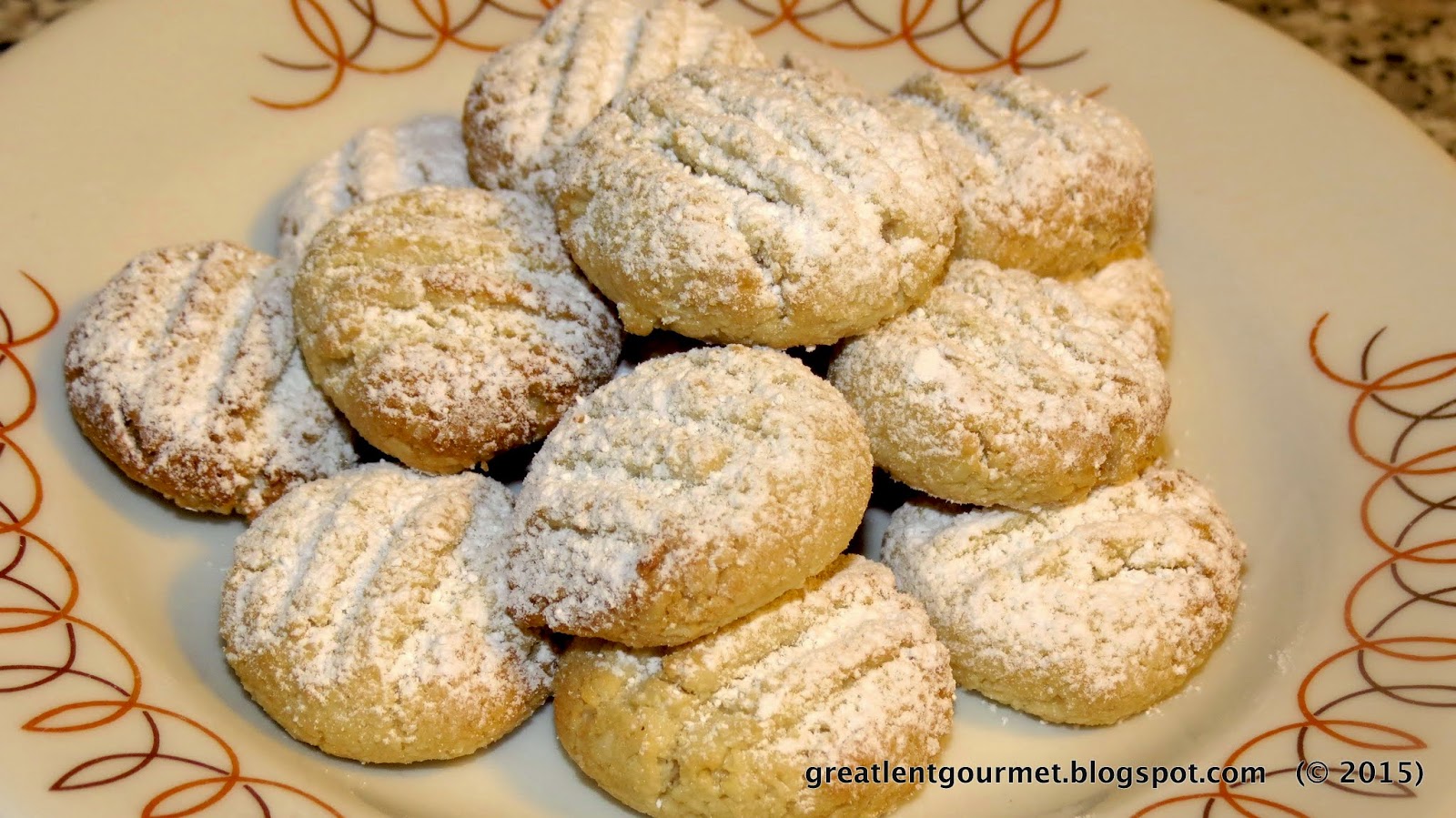
Day 29: March 22, 2015 - Monastery Fasting Cookies With 4 Ingredients - Νηστίσιμα Μπισκότα Μοναστηριού Με 4 Συστατικά


Food from the cookbook Greek Monastery Cookery by Archimandrite Dositheos is sometimes involved, and other times, the recipes are quite simple.  When we saw the recipe for fasting cookies that had only 4 ingredients, we had to try it.  How could anyone pass up an easy cookie like this?  We were not sure what to expect in texture, but, surprisingly, it was a tasty, soft treat with great texture and lingering sweetness.  We understand, now, how the monks would make these, eat one, and be satisfied with just one.

The measurements for this recipe are approximate.  The directions were given in grams (weight), and we converted the measurements to cups for our own convenience.  Therefore, the measurements may not be completely accurate, but they worked out fine.


For this recipe, you will need the following:

3 cups white almonds
1 cup powdered (icing) sugar
3 TBSP honey
1 teaspoon rosewater (can use vanilla, almond extract, ouzo, orange water, or other flavouring)

The directions in the cookbook tell us to mill the almonds.  We took that as grind them, and for that, we used a food processor.  In fact, we put all the ingredients in the food processor and mixed until they reached "a tight dough," as the book directed.  We thought a tight dough meant that we could form a shape with the dough and the shape held.  It was not a smooth dough, although we could have blended it more to make it smooth.  We like the texture of ground almonds, so we left texture in our dough.  The honey, powdered sugar, and water made a nice glue to hold the almond crumbles.


Once the dough is made, make cookie shapes.  We chose to make small balls and flatten the balls with fork tines.  This is a classic method when making peanut butter cookies.  We rolled balls of equal size out of the dough.  Place the cookie balls on a paper-lined cookie sheet, allowing a little space for the cookies to spread.  Then, press the fork into the top of the cookie.  This will flatten the cookie ball into a disc, and will leave the lined imprint of the fork.  Doing this gave us nice round cookies.


Bake the cookies in a "moderate temperature oven."  We baked at 350º F (about 175º C) until the cookies turned light brown.  They baked for approximately 9 minutes at 350º F.  When we saw the cookie edges turning brown, we checked the bottom of the cookie.  Once we saw a nice, even colour on the bottom of the cookie, and it moved freely across the parchment paper, we knew they were done.  There are no raw ingredients to worry about remaining uncooked.

After a moment of cooling the cookies  so they are cool enough to touch, but still warm, sprinkle powdered sugar on top of them.  We used a sifter to make the coating even and light, covering the top of each cookie with the icing sugar.


Allow the cookies to cool completely before serving.  When you sprinkle icing sugar on cookies, you always know when someone takes a cookie before they make it to the table!  These are delicious, flavourful, and just sweet enough.


"Run from places of sin as from the plague. For when fruit is not present, we have no frequent desire to eat it." 

St. John of Climacus (From the Ladder of Divine Ascent, Step 3, Section 9)
Source of quote: